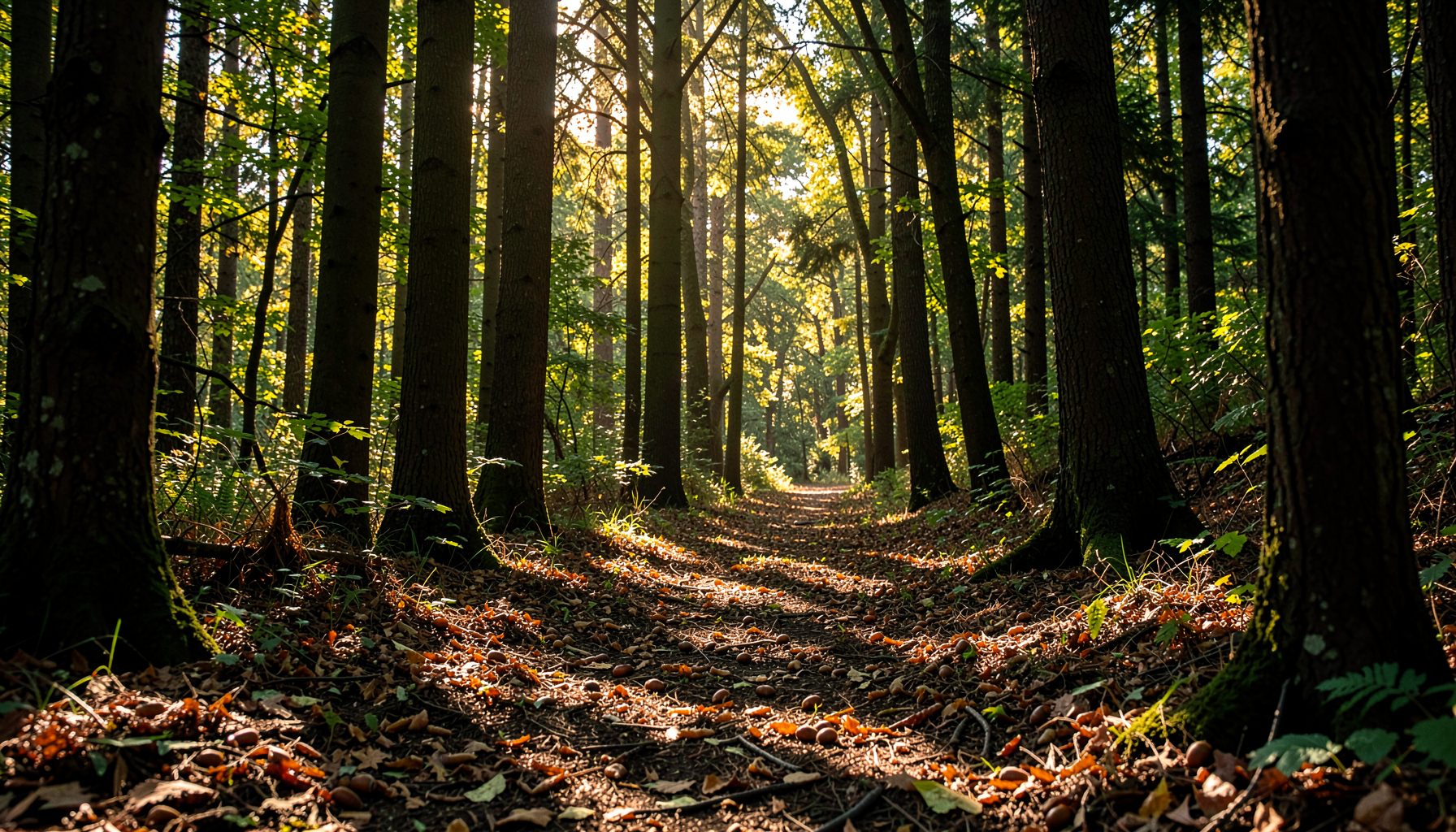
Why volunteers should learn to identify trees by bark in winter
When the deciduous canopy thins out across the Potomac watershed each winter, the volunteers who turn out for seed-collecting weekends lose their most familiar tool: leaves. Oaks, sycamores, birches, and persimmons all stand bare at the very moment when their nuts and capsules are ready to fall. For anyone who has learned tree identification through leaf shape, this season can feel like working with a blindfold on. Yet the trees themselves still carry an identity card that survives the cold, and reading it is a skill that quietly transforms a volunteer program.
Bark changes very little between December and March, which means it is the most stable identifying feature available during the dormant season. A volunteer who can recognise a sapling by its trunk alone can map a restoration site, flag seed parents for state nurseries, and teach newcomers without waiting for spring buds to break. In a watershed where streamside seedlings take years to establish, that early-season accuracy matters enormously for the long game of reforestation.
The practical limits of leaf-based identification in cold months
Botanical field guides are built around summer. Glossy photographs show full crowns, distinct margins, and petioles attached to broad blades, but a January walk rarely matches those images. In the Appalachian foothills and the Piedmont plateau, the same species that volunteers learned in October can look like a thousand grey sticks by January. The temptation is to wait for warmer months, yet acorns and walnuts are most efficiently collected between late autumn and early spring, when they fall cleanly and are still viable for nursery sowing.
Reading bark gets a volunteer through that awkward stretch. The shaggy vertical plates of a mature shagbark hickory, the tight interlacing ridges of a black oak, the smooth muscular limbs of a beech, and the peeling cinnamon curls of a river birch all remain visible year-round. Once a volunteer trains the eye to spot these signatures, mapping seed trees becomes possible on cold mornings when no leaves remain. It also helps when distinguishing native species from invasive look-alikes that have lost their diagnostic foliage, a common confusion in riparian zones where privet, bush honeysuckle, and autumn olive crowd the understory.
What bark reveals about a tree's health and habitat
Bark is not just a label. Its texture, thickness, and colour tell a story about how a tree has grown and what the surrounding site is doing. A deeply furrowed trunk on a bottomland oak suggests years of stable soil and periodic flooding, both of which are good news for the seedlings that will eventually inherit that bank. Peeling or papery bark on a river birch points to wetter ground that dries out seasonally, useful information when choosing where to plant the next generation of streamside stock.
Volunteers who pay attention to bark also catch problems early. Cracks, oozing patches, sunken cankers, and bleached sections all become visible when the eye is trained on the trunk rather than the canopy. Early detection allows a project leader to flag a decline, remove a hazardous stem before a windstorm, or set aside a parent tree that should not be propagated from. There is a quiet satisfaction in reading the trunk like a page and finding the paragraph that explains why a particular bend in the creek no longer holds its soil. Resources such as the native shrubs that stabilise riverbanks guide published by Growing Native sit naturally alongside bark work, because the shrubs that hold a bank are often evaluated by their stems before anything else.
Skill-building for seed collectors and habitat restorers
A winter identification walk is one of the most efficient training events a volunteer program can offer. Participants pair up, choose ten trunks within sight of the trail, and try to name each one without looking up. The exercise quickly surfaces the most common species on a site and the ones that newcomers consistently misread. Within an hour, a small group has produced a working key for that particular restoration area, which can then be printed, laminated, and carried on future outings.
The skill also pays dividends when volunteers are working with school groups, families, or corporate days. A child who can name three trees by their bark is far more engaged than one who is told to wait until May for leaves. The same approach works for visitors from interstate or overseas, who often arrive with strong tree knowledge from their home biomes but no familiarity with mid-Atlantic hardwoods. Practical activities like building a colouring book of streamside trees for kids extend the learning off the trail and into classrooms, where bark rubbings made with crayons become both art and field notes.
Translating American watershed work to Australian landscapes
The techniques developed along the Potomac translate remarkably well to Australian bushcare, where volunteers spend long summers and mild winters restoring riverbanks from the Hawkesbury-Nepean system near Sydney to the Murray-Darling floodplains outside Adelaide. Australian conditions are inverted relative to the Potomac, with dormant seed collection happening in the cooler months of June through August, yet the underlying principle is identical. Strip the leaves and the canopy, and you must rely on bark, bud, and form to know what you are looking at.
Australian volunteers face their own identification puzzles. Eucalyptus bark sheds in ribbons, flakes, and patches in dozens of distinct ways, and a Sydney bushcare group can spend a satisfying afternoon learning to separate a scribbly gum from a grey gum by trunk pattern alone. Along the Brisbane River, the smooth pale trunks of melaleucas and the deeply ridged bark of native figs offer similar lessons in winter form recognition. In Melbourne's Royal Botanic Gardens and the bush reserves of the Yarra Ranges, Landcare volunteers often begin their year with a bark walk before any revegetation planting begins, because knowing what is already there is the foundation of good restoration. Even species familiar in both hemispheres respond differently, which is why volunteers who learned willows and poplars in North America sometimes find the same genera behaving quite differently along the Tamar estuary in Tasmania. Paying attention to bark prevents the simple mistake of treating an Australian endemic as a North American transplant and vice versa.
The connection across hemispheres also runs through the ecology of the trees themselves. Volunteers who have watched a flowering dogwood open its bracts over the Potomac will recognise the same genus's role in a different climate, and resources such as the flowering dogwood as a critical early pollinator food source explain why this genus is so widely valued. The same winter-bare trunks that host nesting birds and foraging marsupials in Australia provide overwintering structure for insects in North America, and recognising the bark is the first step in either country.
Building community knowledge that lasts beyond a single season
Identification skills compound when they are shared. A volunteer who can name a tree by its bark becomes a mentor, a field-trip leader, and a keeper of local knowledge. The information does not vanish when the season turns; it accumulates in photo logs, sketchbooks, and the collective memory of a Landcare or watershed group. After a few winters, the group has built its own regional key, complete with the quirks of local soils, the bark signatures of trees grown on rocky ridges versus river flats, and the small variations that distinguish one watershed from the next.
That knowledge is also what keeps a volunteer program resilient. When regular leaders move away or burn out, a team that has trained its members in bark identification can carry the work forward without missing a season. It is the kind of low-cost, high-value skill that pays off every time someone pulls on work gloves in the cold.
Field habits that sharpen winter bark reading
A short set of habits, practised over a season, will turn bark from an afterthought into a reliable tool for any volunteer.
- Carry a small hand lens and a soft notebook dedicated to bark sketches, with notes on texture, colour, and any scent released by a freshly scratched patch.
- Photograph each trunk at chest height with a ruler or coin in the frame for scale, then revisit the same tree in summer to confirm the identification against the leaves.
- Walk the same transect in different light, since grey bark that looks flat at midday can reveal deep furrows under low winter sun.
- Pair newcomers with experienced identifiers on seed-collection days, so questions are answered on the spot rather than saved for a later workshop.
- Compare notes across sites, since bark patterns can shift between sandy bottomland, rocky slopes, and clay terraces within the same watershed.
- Build a regional cheat sheet that lists the three or four most common species on each project site, ordered by bark rather than by leaf.
Wintry mornings along the river do not have to slow down a restoration season. Volunteers who take the time to learn the language of bark find that the cold months become some of the most productive weeks of the year, full of careful observation, solid mentorship, and seed that lands in the right nursery beds at the right moment. Bring a notebook, choose a tree, and start reading the trunk on the next clear morning. The forest has been speaking all winter, and a steady volunteer eye is the easiest way to listen.