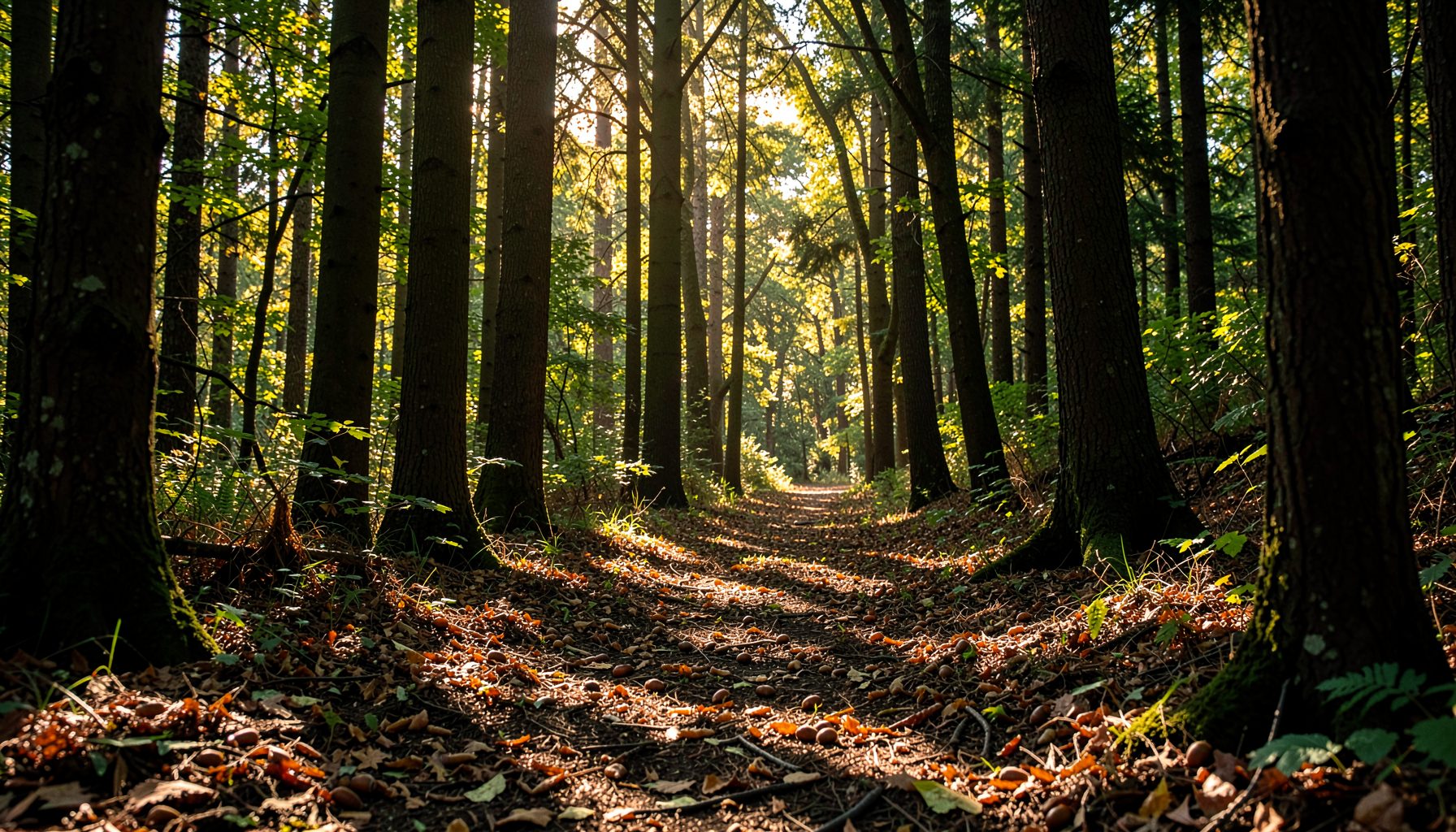
Collecting Seeds from Senescent Trees Preserves Local Genetic Legacy
Seed collection sometimes begins with a tree that appears ready to step back. Its crown may be thinner, branches may show dieback, and much of the foliage can be beyond safe reach. These can be signs of senescence, the gradual loss of vigour associated with ageing. Such a tree may still set viable acorns, walnuts or other fruit, giving restorationists a limited opportunity to capture its genetic contribution before the parent disappears.
This inherited diversity is the local genetic legacy: traits carried by plants that have lived and reproduced within a particular landscape over many generations. It includes adaptations to soil, rainfall, heat, frost, pests and seasonal timing. Seed is not a perfect time capsule because offspring receive a reshuffled mixture of parental genes. It remains a living sample of diversity shaped by local conditions.
Growing Native applies this thinking in the Potomac River watershed, where volunteers collect hardwood and shrub seed for state nurseries. That seed is grown into streamside seedlings used in reforestation and erosion-control projects that support cleaner waterways. The process links a mature tree’s remaining reproductive capacity with the long work of restoring a forest community.
The value of a seed lot depends on more than its age. Accurate species identification, legal permission, parent-tree records, careful handling, appropriate treatment and nursery care all determine whether that genetic material survives. A well-planned collection protects the donor tree and improves the chances that young plants will establish in the same landscape.
Senescent trees as living genetic archives
An ageing tree has accumulated inherited variation over decades, sometimes centuries. Its seeds can carry combinations of genes that proved workable under the pressures experienced by that population. When a local adult is lost, its genes do not vanish automatically: viable seed already dispersed and existing saplings can carry them, while nearby reproductive trees continue the population.
Senescence is not a genetic diagnosis. A tree can decline because of drought, storm damage, soil compaction, disease or physical damage while its seed remains genetically sound. Age also does not make every veteran a superior parent. Useful collections sample several healthy parent trees rather than treating one declining individual as the sole source of a local gene pool.
Old trees also provide cavities, bark, fungi and nesting habitat that a replacement seedling cannot duplicate. The appropriate response is careful, minimal collection from reachable fruit, never felling or stripping a veteran tree. The aim is to save what the tree can naturally offer while leaving the tree itself standing.
Local adaptation in Australian landscapes
Australian conditions make provenance easy to see. Melbourne’s cooler winters and variable rainfall, Sydney’s coastal heat and sandstone soils, Perth’s dry summers and Canberra’s frosts create different selection pressures. For restoration, the relevant sources might be river red gum from a comparable Murray-Darling catchment, swamp mahogany in south-east Queensland, or a wattle proven for a specific Melbourne or Sydney catchment. “Local” should be defined at a meaningful scale, not simply the nearest street.
Permission is also a local reality. There is no single national rule for harvesting native seed in Australia. Crown land and council reserves may impose permit conditions, while state and territory biodiversity laws can restrict protected species and commercial collection. The Commonwealth Environment Protection and Biodiversity Conservation Act applies to certain nationally listed matters, and interstate plant movement can be affected by biosecurity rules. Check the land manager and relevant authority before collecting fruit or plant material.
Everyday habits shape demand. Australian households often compost kitchen waste or place prunings and fruit in council green-waste collections, while bushland volunteers collect seeds on local walks and suburban growers exchange seedlings at community nurseries. The native-plant market includes independent nurseries, council contractors and online suppliers, but provenance can be vague. Better records let buyers distinguish locally appropriate stock from generic seed mixes.
Local source is a sound starting point, not a permanent guarantee. A tree adapted to past rainfall patterns may face a hotter, drier future. Australian restoration planners can pair local provenance with climate-adjusted seed zones, broader parent samples and trials, rather than relying on one ageing tree or one famous catchment.
Collecting seed with care and permission
Plan each visit around the species, not a single date. Record the parent tree, its location, date, habitat and condition; use several parents across suitable sites; and collect only ripe, undamaged fruit when it can be reached without pruning. Species mature at different times, and Australian rainfall patterns can shift the window. Approach from the ground where possible and avoid climbing unstable limbs.
For walnuts, experienced guidance on the walnut branch-shaking method shows how ripe nuts can be released without cutting branches. The same low-impact principle applies to acorns and other fruits: gather what the tree drops, protect the donor, and never remove more material than the programme needs. Handling protocols may matter where nuts are collected for nurseries rather than personal use.
A good collector also knows what not to take. Some rare or culturally important plants require special approval, and a permit for seed does not automatically authorise removal from a particular reserve. Avoid protected stands, uncertain species and trees showing dangerous structural decay. Ask a local botanical expert or land manager when identification or safety is unclear, and never approach a tree that must be removed for safety reasons.
From field collection to nursery readiness
Fruit should be handled gently and kept cool, shaded and ventilated. Separate sound seed from mouldy material, follow species-specific cleaning methods, and dry seed to an appropriate moisture level before storage. Wet seed can heat, develop mould or lose viability, so collection containers should not be left in a hot car or direct Australian sun.
Dormancy is another reason timing and treatment matter. A species-specific protocol may include chilling, moisture control and a period in sand or another medium. The winter seed stratification guide explains how suitable chilling can encourage germination, while also making clear that one treatment cannot suit every tree or shrub.
A traceable seed lot gives nursery staff the information they need. Include species, parent identifiers, collection dates, coordinates at an appropriate level of precision, habitat notes and any treatment already applied. If seed moves between regions or states, check relevant biosecurity and nursery intake requirements before transport. Strong records allow seedlings to be allocated to suitable restoration sites.
Practical checklists for seeds and seedlings
Careful preparation turns a short collection window into a durable contribution. The first checklist protects trees, permits and genetic breadth; the second keeps the recovered seed viable and traceable.
Collection checklist
- Confirm land-manager permission, species identity and any protected-status requirements before collecting.
- Sample several mature parents and reachable, undamaged fruit rather than stripping a single tree.
- Record parent identifiers, location, date, tree condition and visible habitat details.
- Keep lots separate, avoid hot vehicles and retain enough material for the nursery without over-collecting.
A single tree can offer useful genes, but a balanced seed lot reduces the risk of an unusually narrow family and gives the nursery more resilience.
Nursery and planting checklist
- Clean, dry, store and stratify each species according to its known treatment requirements.
- Retain collection and handling records with the seed lot through cleaning and germination.
- Grow seedlings in suitable soils and prepare planting sites for local moisture, fire and flood regimes.
- Coordinate nursery orders, planting dates and establishment monitoring with local restoration groups.
Used together, these lists make collection reproducible and reduce losses between the parent tree, the nursery bench and the planting site.
Restore local forests and waterways
After germination, local seedlings can stabilise creek banks, replace losses on eroded slopes and reconnect wildlife corridors. Species chosen for a site should match its hydrology and soil, not merely look familiar. Nursery staff and restoration crews can use provenance records to plan diverse plantings that meet the needs of Australian urban and rural catchments.
The contrast becomes clear when the sources are compared:
| Consideration | Seed from local senescent parents | Seed from unknown or non-local stock |
|---|---|---|
| Provenance | Parent trees, sites and dates can be documented | Origin may be unclear, broad or mismatched to the site |
| Local adaptation | Includes traits selected through many local generations | May lack adaptation to local soils, climate or seasonal timing |
| Genetic breadth | Several parent trees can preserve useful within-population variation | One source can narrow diversity, while mixes can have unknown relatedness |
| Climate outlook | Provides a baseline that can guide future trials and seed zones | May need more adjustment where climate and growing seasons are shifting |
| Restoration value | Supports ecological continuity when collection and nursery records are sound | Can still grow, but expected performance and provenance are harder to justify |
No source is automatically perfect. A senescent parent may have few viable seeds, and a non-local source may be appropriate when the receiving site has changed substantially. The comparison supports informed decisions, not blanket rules.
Restoration begins when a community decides that the next forest should inherit more than a generic catalogue label. Volunteers can record parent trees, gather permitted seed, prepare it for nurseries and support planting along streams. Explore the Growing Native restoration network for volunteer days, family and school activities, workplace projects and practical species-identification guidance. Each documented seed lot can carry a local story forward, helping new woodland and creek-bank plantings become part of a living forest rather than a disconnected planting.