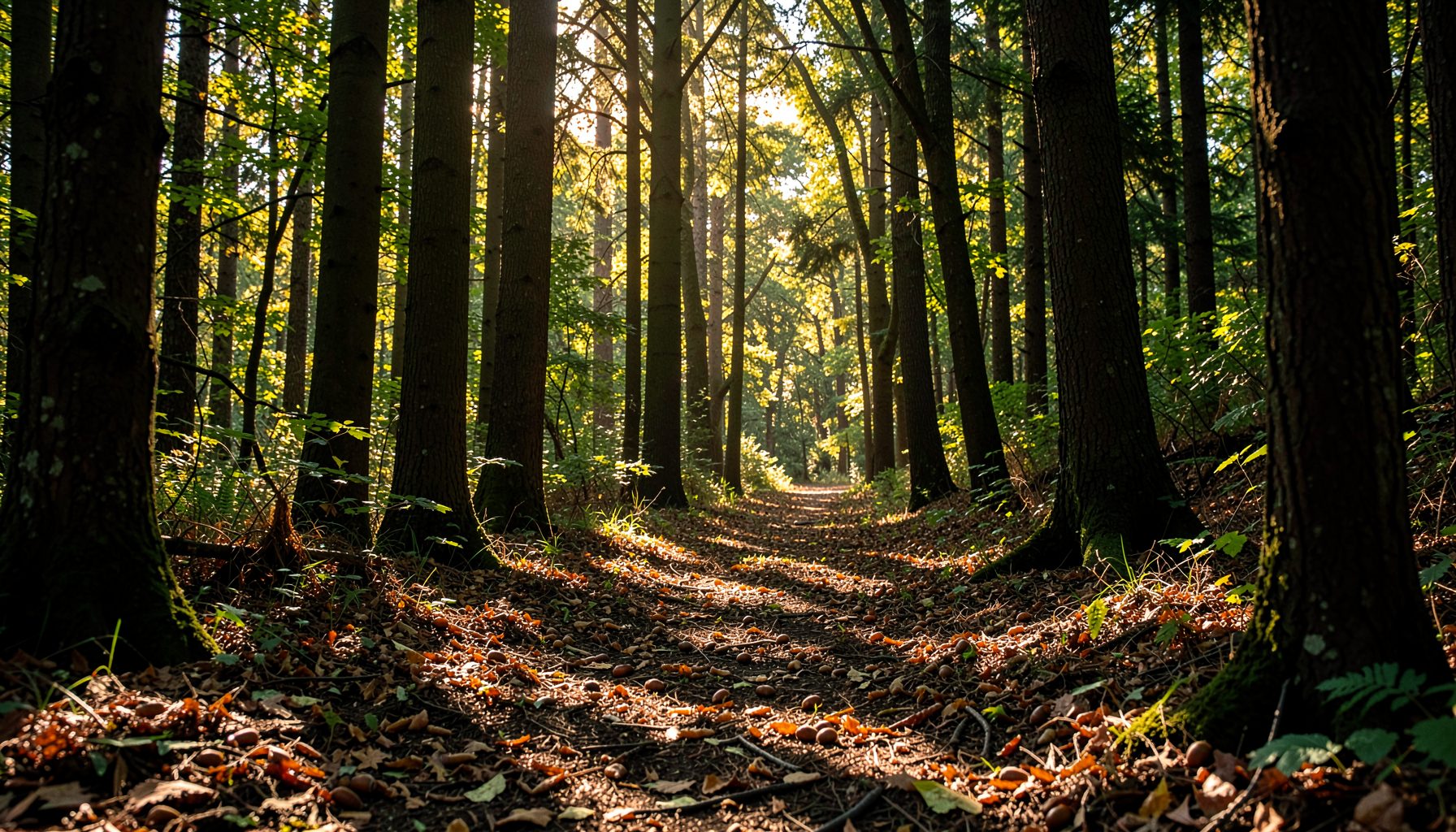
Why Canopy Gaps Reveal Shade-Tolerant Seedlings
A canopy gap is an opening in forest cover created when a mature tree falls, a crown dies back, or a disturbance removes several limbs. Light begins to reach the forest floor, changing the temperature, moisture and competition experienced by plants below. The opening may look abrupt from a distance, but its edges often contain a sheltered transition zone where young trees can establish without full exposure.
Shade-tolerant seedlings are adapted to low light and can persist beneath a closed canopy as “advance regeneration.” They become easier to notice when a gap brightens their surroundings, although the most exposed centre may favour fast-growing pioneer species. The useful survey area is often the shaded edge, beneath surviving branches or beside a fallen trunk, where filtered light meets reliable soil moisture.
Finding these seedlings requires more than spotting green growth. Their leaves, stems and root position reveal whether they are genuinely adapted to shade or merely suffering from sun and drought stress. Leaf litter, canopy direction, nearby roots and browsing pressure all influence whether a young plant can survive long after the observer leaves.
The same principles apply across Australian forests and urban bushland, where land managers talk about understorey, “regen” and restoring creek lines. Growing Native applies a related restoration model in the Potomac River watershed, collecting native tree and shrub seed for state nurseries that grow seedlings for streamside planting. Australian readers can use its volunteer-led approach while applying local knowledge of species, provenance and climate.
What makes a canopy gap different
A gap changes the balance of light and competition. When a large tree falls, its roots may leave a nutrient-rich soil pocket, while the opening receives rain that previously was intercepted by foliage. Decaying wood can also shelter seedlings and hold moisture. Yet a wide, bare gap can become hot and dry, favouring species that tolerate exposure rather than those that need shelter.
The most promising shade-tolerant plants are often along the north and south margins in the Southern Hemisphere, depending on aspect and latitude. A single fallen branch can create enough light for detection while leaving overhead cover intact. In dense rainforest, that narrow band may be the only place where a sapling becomes visible without being overwhelmed by vines or mature trees.
Gap size alone does not determine what will grow. Small openings beneath the main canopy, forest-edge light and gaps beside standing dead trees can all support regeneration. The observer should ask whether the opening is temporary or persistent and whether neighbouring crowns are likely to close it again.
Reading light, soil and shelter
Filtered light often produces broad, thin leaves and stems that lean towards brighter spaces. These features can indicate shade adaptation, but severe stretching, pale foliage and scorched leaf margins suggest heat or water stress instead. Morning observation of sun patches can help distinguish regular shade from the intense exposure of a clear summer afternoon.
Soil moisture should be checked below the leaf litter rather than only at the surface. A healthy sheltered seedbed is dark, crumbly and slightly moist, with no deep compaction from people or machinery. Fallen logs may provide excellent cover, although seedlings growing directly through a decayed trunk can be unstable and should not be disturbed.
Competition is another key factor. Large roots, dense fern growth, bamboo-like suckers and invasive weeds can occupy the same small area that appears open to a visitor. Shade-tolerant seedlings may survive under closed forest where they face less heat, so their absence from a gap does not mean they are absent from the forest.
Where volunteers can learn by doing
Volunteer seed collection and planting offer practical experience with seedlings that local forests are expected to support. Growing Native organises families, schools, community groups and workplaces to collect native hardwood and shrub seed, including acorns and walnuts. The seed is donated to state nurseries, where it is grown into trees for streamside restoration.
People interested in this work can explore volunteer sites to find suitable activities. Good training connects seed identification with forest ecology, canopy structure and watershed health. It also teaches participants to notice natural regeneration without uprooting it, since wild seedlings are usually more valuable where they already grow.
Field learning becomes more useful when volunteers record light, soil conditions, species and location before making a management decision. A photograph taken from the same direction, notes about canopy cover and a small tag on a nearby stem can make monitoring much easier. Such records reveal whether a seedling is merely dormant, browsed or actively producing new growth.
Comparing the main canopy positions
| Position | Light and moisture | Likely regeneration | Appropriate response |
|---|---|---|---|
| Exposed gap centre | Strong light, variable moisture and higher temperature | Pioneer species and stressed saplings | Reduce further disturbance and monitor exposure |
| Gap edge | Filtered light with some overhead cover | Young trees adapted to partial shade | Protect competing vegetation and retain leaf litter |
| Beneath surviving canopy | Low light, cooler and often moister | Strong shade-tolerant seedlings | Limit trampling and browsing |
| Small sub-canopy opening | Patchy light near branches or fallen wood | Mixed regeneration, often easy to overlook | Survey carefully and record marked seedlings |
No position guarantees establishment. Soil history, root competition, storm damage and the cause of the opening can matter as much as current light. A narrow gap beside a veteran tree may support an exceptional understorey seedling, while a large clearing may become dominated by grasses. Field judgement therefore matters more than a simple rule about sunlight.
Signs that regeneration is taking hold
Look for these signs when deciding whether a young plant is secure under partial shade. Good indicators include multiple leaves, an intact growing tip and new growth that matches the colour of older foliage. A seedling that appears weak may still recover once competition or browsing pressure is reduced.
- An intact terminal bud with several healthy leaves
- Broad, well-spaced foliage rather than long, pale stems
- New growth matching the colour of mature leaves
- Roots surrounded by moist, uncompacted soil
- Protection from heat, wind and exposed root plates
Before recording or managing a site, check for specific hazards that could explain poor growth. These checks protect both the seedling and the volunteer inspecting it.
- Scorched leaves or a dried root zone
- Compacted soil caused by foot traffic or vehicles
- Browse marks from rabbits, wallabies, deer or livestock
- Dense weeds, vines or aggressive native suckers
- Uncertain identity, hybrid origin or unsuitable nursery provenance
Adapting the method to Australian landscapes
Australian conditions make local knowledge essential. In the Blue Mountains, wet eucalypt forests often contain cool gullies where treefall openings create moist but root-competitive sites. Around Wollemi Gorge and in the Daintree, dense subtropical and temperate rainforest can hide juvenile trees beneath vines and palms. In Tasmania, wind and seasonal drying can make sheltered stream margins more reliable than exposed forest gaps.
Australian restoration crews commonly call natural young trees “regen” and use terms such as understorey, gully and creek line when describing sites. Provenance also carries more weight than in many simplified planting programs: seedlings raised from local seed are generally preferred for local councils, Landcare groups and catchment organisations. Nursery markets often distinguish plants by seed origin, growth form and local ecotype.
That local detail differs from the Potomac workflow. Acorns and walnuts collected by Growing Native are appropriate native tree and shrub resources within its watershed, while Australian projects commonly work with eucalypts, wattles, she-oaks and regionally native shrubs. The volunteer experience described in Growing Native’s volunteer testimonials still illustrates a transferable principle: repeated contact with a site teaches people to notice small changes that a single visit would miss.
Put the finding to work
The most useful result of a canopy-gap survey is a clearer understanding of regeneration. Mark seedlings without moving them, photograph the surrounding canopy, and return after rain, wind or a growing season. Compare leaf condition, stem height and new growth rather than judging establishment from a single glance.
Protecting a young shade-tolerant tree may mean keeping people on a defined path, retaining fallen wood and leaf litter, controlling invasive plants, or reducing browsing. In a restoration planting, the survey can identify where nursery trees are most needed and which natural seedlings should remain undisturbed. For urban bushland, that knowledge can also guide council contracts and local nursery orders so planting supplements regeneration instead of replacing it.
For hands-on involvement in Growing Native’s Potomac restoration activities, visitors can contact Growing Native to ask about seed collection, nursery work and community planting days. Join a field session, record the seedlings you observe, and help strengthen the understorey that will carry future forest cover.