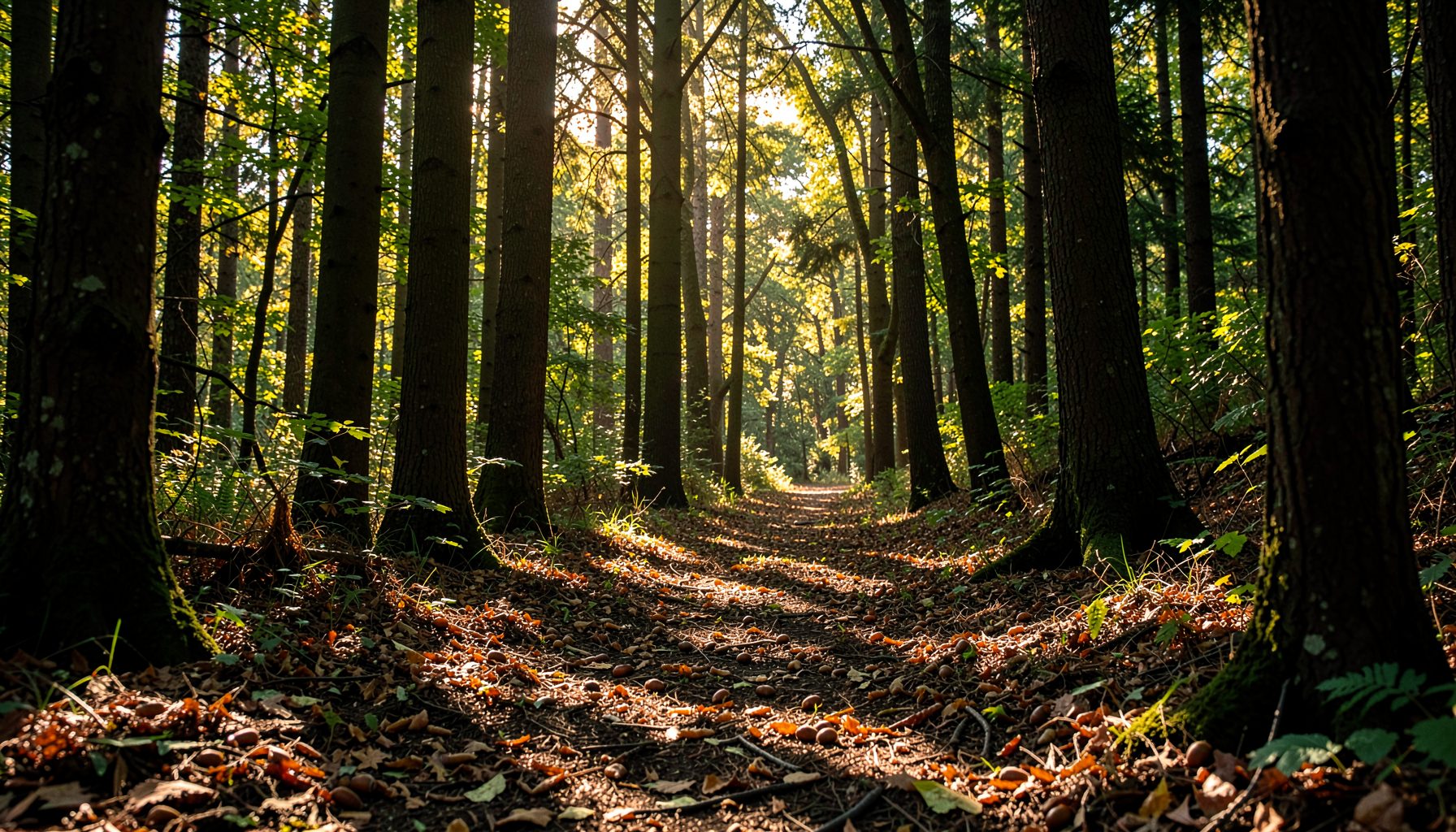
Oak Mast Years and the Health of Forest Communities
An oak tree can look unchanged from one autumn to the next, yet its reproductive output can swing dramatically. In a strong year, a crown may carry thousands of acorns; in another, it may produce very few. This concentrated seed release is called a mast, and the interval between productive years is part of an oak’s masting cycle. Such pulses are normal, not a sign that something has gone wrong.
Understanding the connection between oak masting cycles and forest health helps explain why wildlife, seedlings and soils can all seem busy in one season and quiet in another. It also improves decisions about seed collection: a large crop is useful for restoration, but it should not be treated as an unlimited reserve.
For Australian readers, the subject needs a local lens. Most native forests are dominated by eucalypts rather than oaks, and eucalypts also produce irregular, weather-responsive seed crops. The species differ, yet the ecological pattern is familiar: good years feed animals, poor years expose gaps, and drought, heat and fire can rewrite the rhythm.
What a mast year actually means
Mast is the ecological term for a large production of seeds or fruits across many plants at the same time. In an oak forest, it usually refers to an exceptional acorn crop. “Exceptional” does not mean unusual in a damaging sense; it means noticeably more abundant than in a light year, often with more trees participating in the event.
Oaks commonly invest heavily in reproduction every few years, although individual species vary. Some produce strong crops at intervals of roughly two to five years, while others follow less predictable patterns. Black walnut, for example, is known for alternating years of heavier and lighter nut production. Synchronised reproduction gives wind-pollinated trees a better chance of fertilising one another during favourable weather.
Seed collection should begin with accurate identification. Growing Native’s black walnut versus butternut guide offers a practical North American example, but Australian plant identification guides and local biosecurity rules should take priority for anyone collecting seeds there.
Seeds reshape food webs and soils
A heavy acorn crop can support a whole community of animals. Squirrels, jays, parrots, rodents, deer and invertebrates feed on the seeds or the insects associated with them. Predators then respond to the sudden increase in prey. Australian eucalypt forests show a comparable pulse: cockatoos, lorikeets, ants and other animals may gather around prolific capsule crops, only to become less conspicuous when seed production falls.
These changes can affect the forest beyond the animals that eat acorns. Seeds that escape predation may germinate, while caches buried by rodents can later produce seedlings. At the same time, animals may spend more time foraging in the soil, alter nutrient cycling and influence the survival of young plants. The result is not a simple chain from more acorns to more trees; it is a rearrangement of interactions across the forest floor.
Acorn and fruit litter also contributes carbon, organic matter and nutrients. High-output years can produce a measurable litter pulse, although tannins and other compounds may temporarily alter decomposition or microbial activity. Effects vary with soil type, moisture and species, so a heavy crop should not automatically be interpreted as a sign of soil enrichment or perfect ecological balance.
Weather, fire and Australian parallels
Weather influences flowering, seed development and the timing of mast production. Cool spring conditions can reduce pollination success, while drought may prevent acorns from filling properly. Warm autumns can accelerate seed drop, and storms can knock fruit to the ground before it is mature. Regional weather patterns help explain why oaks across a broad area may crop heavily in the same year.
Australian readers will recognise similar uncertainty in eucalypt forests around Melbourne, Canberra and Sydney. Rainfall varies sharply between coastal and inland areas, and El Niño and La Niña cycles can influence drought, heat and storm patterns. Bushland fragments in and around these cities also experience heat, soil compaction and altered fire regimes, all of which affect flowering and seed survival.
Fire adds another layer. In some eucalypt systems, fire can release stored seed and open space for regeneration; in others, severe or frequent fire damages the forest community. Oak woodland responses depend on the species, soil and fire history. The shared lesson is that seed abundance is closely tied to disturbance history and local conditions rather than operating independently of them.
Why abundance does not equal forest health
A productive crown tells us that a tree has sufficient resources for a large reproductive effort. It does not reveal the entire condition of the forest. A stand may produce abundant acorns while suffering from drought stress, invasive plants, compacted soil, insect damage or a shortage of young trees. Forest health depends on the combined condition of trees, soils, fungi, wildlife and regeneration.
Age and diversity provide important buffers. A woodland containing several oak species, compatible shrubs and multiple age classes is more likely to withstand a poor mast year than a uniform plantation of genetically similar trees. Mycorrhizal fungi also matter because they help tree roots acquire water and nutrients. Heavy seed production cannot compensate for a landscape in which seedlings cannot establish.
Timing gaps deserve particular attention. When mast years become less reliable, seed-eating animals may struggle between crops. Birds and mammals may also breed at different times from peak seed availability. This can weaken the flow of nutrients from seeds to seedlings and increase competition during a poor year. In fragmented landscapes, where animals have less room to move between suitable habitat, those gaps can become more severe.
Collecting seed without weakening forests
Restoration projects need seeds, but they also need a strategy that protects existing wildlife and retains genetic diversity. Collectors should learn which trees are healthy, select from several parent trees, record provenance and avoid taking the entire crop. Seeds are most useful when they can be traced to a suitable site and handled according to the requirements of the species.
Growing Native’s responsible seed collection guidance explains how volunteers can select material while leaving enough for wildlife. The organisation gathers native hardwood and shrub seeds, including acorns and walnuts, across the Potomac River watershed and donates them to state nurseries. Those nurseries grow the seed into seedlings for streamside restoration, linking a seasonal forest process with cleaner water and erosion control.
Australian nurseries and councils also use native seed for revegetation, urban bushland recovery and habitat corridors. Demand varies by state, and locally sourced plants are often preferred for climate suitability. Before collecting or moving any seed, check state and local rules: the Commonwealth Environment Protection and Biodiversity Conservation Act 1999 covers nationally significant environmental matters, while state agencies and councils may impose collection permits, protected-area restrictions and interstate biosecurity requirements.
A practical checklist for resilient restoration
A sound restoration plan begins with the site rather than the seed crop. It considers soil, moisture, sunlight, existing vegetation, fire history and the purpose of the planting. This matters in Australia because a site around Sydney may have coastal influences very different from those near Canberra or Melbourne, even when the named species is the same.
- Map the site’s soil, drainage and exposure, then select species suited to those conditions rather than choosing a tree first.
- Watch several mature trees and record flowering, fruit development and natural seed fall across more than one season.
- Gather from multiple healthy parent trees within the target region to retain genetic variation.
- Match local provenance where possible, especially for plants intended for urban bushland or wildlife corridors.
- Leave ample seed for birds, mammals and invertebrates, and avoid stripping every productive tree in an area.
- Follow species-specific handling guidance, because acorns often lose viability if allowed to dry and imported seed may breach biosecurity rules.
- Record collection locations, quantities and survival results so nurseries and land managers can improve future plantings.
Following these steps keeps restoration within the limits of the forest’s natural cycles. A seed program should increase future habitat without consuming the resources that sustain present wildlife, and every collection decision should account for both the tree and the community around it.
Help build the next forest
The strongest restoration efforts combine scientific knowledge with repeated local action. People learn to recognise fruiting seasons, understand which changes indicate stress and see how a good seed year can support many species. That knowledge becomes useful when it is shared through field days, nursery work and long-term monitoring.
Growing Native offers volunteer opportunities for individuals, families, schools, community groups and workplaces, supported by educational resources on tree identification, forest ecology and watershed health. Participants can collect seeds, prepare planting sites and contribute to seedlings destined for restoration along streams.
The next productive season will arrive on its own, but good stewardship cannot wait until then. Join a Growing Native volunteer activity, support a local Australian native nursery, or begin recording tree fruiting in a nearby park or street. Every carefully sourced seed and every protected habitat can carry a forest’s recovery into the next generation.