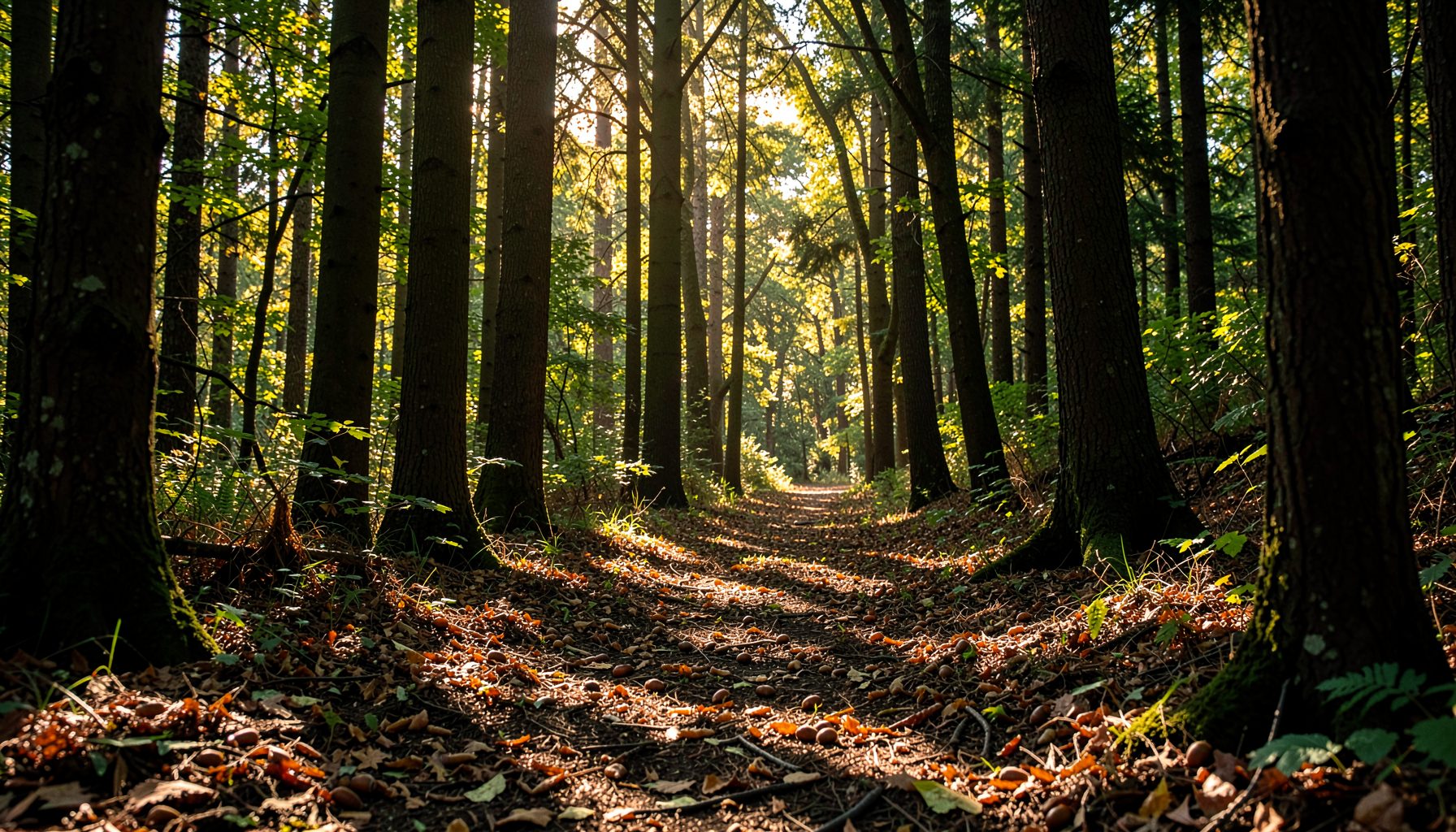
Fungal networks give young trees a stronger start
Restoring a creek bank with native trees is a practical way to rebuild habitat, shade fragile soil and improve water quality. Across Australia, that work often involves eucalypts, wattles and riparian shrubs planted after drought, fire, flood or urban development. Their success depends on more than putting a seedling in the ground; the surrounding soil and its fungal community can strongly shape early establishment.
Below ground, mycorrhizal fungi form networks around or within fine tree roots, trading mineral nutrients and water for plant carbon. These partnerships are especially influential while a young tree has few roots and little stored energy. They are not a substitute for suitable species, drainage and aftercare, however, and a poorly matched fungal community can limit the gains people expect from a planting.
How fungal partnerships work
Most tree species rely on one of two broad mycorrhizal partnerships. Eucalyptus and walnut commonly associate with ectomycorrhizal fungi, whose hyphae form a sheath around fine roots and spread through the soil. Many Australian wattles and other broadleaf species associate with arbuscular mycorrhizal fungi, which grow inside root cells. The partners differ, but both can improve access to phosphorus, nitrogen, water and some protective compounds.
Fungal threads are far finer than roots, allowing a tree to draw from microscopic pores that its own roots may not reach. In return, the plant supplies carbon compounds generated by photosynthesis. This exchange can improve root exploration, soil aggregation and drought tolerance. A healthy fungal mantle may also improve a seedling’s tolerance of moisture stress following nursery growth and transplanting.
Commonly called the wood wide web, these networks have sometimes been described as cooperative pathways that share resources among plants. Field evidence supports transfer under some conditions, yet it is not equally strong between every species or fungal group. Compatibility, fungal abundance, soil moisture and distance all matter. For restoration, the practical aim is a diverse, functioning soil community rather than promises that one fungus will feed an entire grove.
Preparing Australian planting sites
Australian planting sites present a difficult mix of pressures. Melbourne’s urban creeks and Brisbane’s suburban waterways may carry compacted fill, while restoration areas around Canberra often face drought and low organic matter. Heavy rain can then wash soil away before roots have held it together. Calling in a tree after a storm is useful, but treating compacted ground and unstable banks is the first step towards useful fungal colonisation.
Before planting, crews can loosen compacted soil without turning it into a fine, sterile medium. Broad ripping, shallow decompaction and adding well-rotted organic matter create pores for fungal hyphae and tree roots alike. On saturated sites, drains and mound planting may be more valuable than extra fertiliser. Excess phosphorus can discourage mycorrhizal colonisation, so fertiliser should follow a soil test rather than generous routine applications.
Stocks sold through Australian garden centres and wholesale nurseries vary in the fungal partners carried from production. Tube stock grown in clean, sterilised or highly uniform potting mix may arrive with fewer fungal spores than a locally grown plant with intact nursery soil. Local provenance remains important because climate, soil and rainfall shape both tree adaptation and the fungi available nearby. Buying trees from a reputable native nursery gives landholders access to advice as well as stock.
Matching trees, fungi and nearby habitat
Matching a tree to its likely fungal partners begins with local ecology. A eucalypt planted for a creek in southeastern Australia may meet different fungi from those encountered by the same species in tropical Queensland. Many eucalypts use ectomycorrhizal fungi, while many Acacia rely on arbuscular partners, although responses vary among species and sites. Seed from a nearby parent population, combined with fungi already present in the target soil, offers a safer starting point than transporting assumptions between regions.
Species diversity creates overlapping root zones and several routes for water and nutrient uptake. Shrubs and groundcovers can maintain living roots and fungal partners between tree plantings, while flowering plants support insects that visit the recovering habitat. Mixed plantings should still respect waterlogging, salt exposure and mature tree size. Dense roots around a stream can compete for scarce moisture, so spacing and long-term canopy plans matter as much as immediate fungal connections.
Community nurseries can build mycorrhizal continuity by using local soil, retaining suitable returned nursery media and avoiding unnecessary sterilisation. The value of collaboration is illustrated by arboretum seed partnerships, which connect seed events with specialist growing expertise. Australian Landcare groups, local councils and community nurseries can adapt that approach during National Tree Day, while preventing the spread of weeds and respecting state biosecurity rules when materials move between sites.
Actions that improve tree establishment
Useful mycorrhizal work is mostly careful, unglamorous and well timed. It starts before planting, continues through establishment and depends on people who return to check moisture, mulch and damage. The following actions connect fungal ecology with tasks volunteers and crews can carry out without pretending that an inoculant alone can replace sound site preparation.
For planting crews
- Test drainage and compaction across the planting strip, then repair wet or compacted zones before ordering trees.
- Use locally appropriate nursery stock and ask suppliers about soil handling and fungal inoculum.
- Keep soil structure open with shallow ripping, suitable planting holes and no unnecessary fertiliser.
- Maintain broad mulch over the root zone without burying the stem or creating a wet collar.
- Water deeply during dry spells, especially in the first two summers, and record every replanting.
For volunteers and tree keepers
- Learn to identify the planted species, its expected form and signs of water stress or root damage.
- Observe soil beneath mulch for fungi, insects and crusts, recording findings without disturbing the root zone.
- Remove competing weeds by hand and replace mulch that has compacted against the trunk.
- Share field observations with the nursery, arboretum or restoration coordinator so future stock matches site conditions.
- Join a scheduled monitoring session rather than making a one-off visit and assuming the tree is thriving.
Commercial fungal inoculants can be useful where the right fungus is absent, but their performance depends on the product, host and soil. Treat them as one treatment rather than a guaranteed treatment. The strongest results come from combining sound planting, compatible fungi, adequate water and patience, with monitoring able to identify problems before a stressed tree loses its root connections.
Tracking whether the partnership is working
Monitoring should show whether seedlings are becoming functional trees, not merely whether their stems remain green. Useful measures include survival, height and diameter growth, new root extension, canopy condition and changes in soil moisture. Fungal colonisation can be assessed on carefully selected root samples, while records of fungi on soil or nearby plants offer a less invasive indication that suitable partners are present.
Record results by planting zone rather than averaging across a whole site. A shaded bank, a road edge and an exposed floodplain can support very different fungal communities, and one failure may be masked by strong growth elsewhere. Repeated photographs, marked trees and simple weather notes make patterns easier to recognise. Soil temperature, irrigation and nearby construction can explain changes that a yearly survival count misses.
Careful language matters when linking fungi to carbon benefits. Healthy trees store more carbon than stressed seedlings, and mycorrhizal networks may accelerate recovery in favourable conditions. Growing Native, a nonprofit restoring forests and waterways across the Potomac River watershed, explains why durable seedlings are the foundation of sequestration in its account of seed collection and carbon. Networks should therefore be presented as one part of a restoration strategy that includes suitable species, long-term survival and protection of mature habitat.
Start by choosing one council, Landcare branch, local arboretum or native nursery in your catchment. Ask which fungal and soil practices they use, then invite them to share that knowledge at a planting day. Small groups can test a simple monitoring approach on one creek bank and use the results to improve the next planting.
People connected with Growing Native can begin by checking its volunteer planting sites, where they can collect native seeds, support streamside seedling production or help monitor young trees. Elsewhere in Australia, translate the same seed-to-seedling approach through a local council, Landcare group or community nursery. Choose one upcoming site, share the event, and give each young tree the time and care required to become a long-lived part of the watershed.