Old Photographs as a Map for Forgotten Oak Groves
Every now and then, a sepia snapshot reveals what the bush has long since hidden: a mighty oak, broad-crowned and heavy with acorns, standing alone where today only bracken and wattle grow. For seed collectors across the Potomac watershed and beyond, these glimpses from the past can be worth their weight in seedlings.
Australia does not boast native Quercus species, yet the techniques used to track down historic oak stands have real relevance for Landcare groups and bushwalkers on this side of the Pacific. Heritage oaks — many planted by early settlers or naturalised in cool, damp gullies — still survive in pockets of Tasmania's Derwent Valley, the high country around Mount Field, and the green folds of Victoria's Dandenongs. Aussie volunteers keen on comparative forestry can borrow many of these same sleuthing skills.
The premise is straightforward. Old photographs capture trees that storms, logging, or land clearing have since removed. They also reveal where cattle were kept out of certain paddocks, where a homestead once shaded its northeast corner, or where a boundary fence once ran through a stand of mature timber. With the right materials and patience, you can piece together a working map of where oaks used to thrive.
This piece walks through how to gather, analyse, and act on those images — from the first trip to the local history room to the moment you confirm a living, seed-bearing tree in a forgotten corner of the catchment.
The Hidden Record in Old Photographs
Photographs taken between the 1880s and the 1960s hold extraordinary ecological information, even when they were not intended as botanical records. Family portraits taken in front of a homestead often include the yard tree, and wedding groups pose beneath a venerable oak whose trunk spans three metres. Postcards printed for tourism in the early twentieth century frequently framed a village's most photogenic specimen trees, and school photographs from one-teacher bush schools sometimes captured the full sweep of the surrounding paddocks.
The challenge is that none of these images come labelled with GPS coordinates. A photograph tells you a tree was here, but not where "here" actually is. The trick lies in matching each picture against surviving landmarks: chimneys, fence lines, gate posts, the curve of a creek, the silhouette of a distant hill. In Australia, creek systems are particularly useful markers; a stretch of watercourse rarely shifts more than a few metres over a human generation. If your photograph shows a massive oak where a waterway forks, that bend is still there today.
It also helps to think about why the photographer chose that particular tree. Old oaks were the social heart of an old rural community, shading the shearing shed and holding the bell at the one-room schoolhouse. When an image repeatedly centres on a single trunk, you are usually looking at a gathering point that has shaped local life for generations.
Sourcing the Right Kind of Images
Start close to home. Local historical societies, country libraries, and school archives in Australia hold donated glass-plate negatives, family albums, and council photography collections. The State Library of Victoria, the State Library of New South Wales, and the Tasmanian Archive and Heritage Office maintain searchable databases with high-resolution scans, often downloadable for non-commercial use. Across the Tasman, Archives New Zealand does the same. For North American collections, the Library of Congress, the US Geological Survey, and university special collections hold vast holdings.
Do not overlook the more humble sources. Trove, Australia's national digitisation portal, indexes community newsletters, local papers, and society journals where photographs of bush gatherings and sporting days were published. Captions can be terse, sometimes only listing a surname, but the images themselves often include enough background detail — a known road junction, a labelled bridge, a town hall with a distinctive clock tower — to fix the location.
You will also want aerial photography. The 1940s and 1950s saw the first systematic aerial surveys across much of the temperate world, and crown shapes throw distinct shadows even at altitude. A mature oak in a paddock appears as a dark, lobed disc against lighter grass. The USGS EarthExplorer platform hosts comparable coverage for North America, while many Australian state agencies hold scanned mosaics of these early flights. Cross-referencing a vertical aerial with an oblique ground-level photograph is one of the most reliable ways to pin down a vanished stand.
Reading the Landscape in Vintage Frames
Once you have a stack of candidate images, the real work begins. Look first at the soil and groundcover indicators. Old photographs often show bare earth around a tree trunk where stock camped beneath it for shade. If your picture shows an oak ringed by a pale, dusty patch against darker pasture, you are looking at what was once a regular camp site, and the spot may still show as a slightly different sward composition even a century later.
Pay attention to the season. A photograph taken in late summer will show full crown density; one from early spring, before leaf-out, will reveal the branching architecture and any structural damage. Australian oaks — mostly English oak, Quercus robur, and a few sessile and Turkey oaks — hold their leaves well into winter in cooler Tasmania, which makes them easier to spot in old winter shots where surrounding eucalypts are bare or sparse.
Notice, too, the company the tree keeps. Historic oaks in rural landscapes rarely grew alone; they were often planted along fence lines, near stockyards, or in shelter belts. A photograph showing three or four mature oaks in a row probably captures a deliberate planting, hinted at today by a faint depression or a row of younger suckers. Seed collectors prize these because parent trees of known common origin make for more genetically consistent nursery stock. The Growing Native program offers a useful overview of seed collection protocols that explains how stand origin affects seedling genetics.
Cross-Referencing With Maps and Cadastral Records
Photographs give you trees; maps give you places. The two become powerful when combined. Start with the historic cadastral maps held by your state or territory land titles office. These show nineteenth-century parcel boundaries, often with notes about vegetation, fence types, and the names of adjoining property owners. A parcel labelled "Old Smith paddock" or "Homestead block" is far more likely to contain a relic oak than one labelled "Scrub block" or "Timber reserve".
Overlay candidates onto modern topographic layers, looking for matches between photographed fence lines and current fencelines. In NSW, the SIX Maps viewer lets you toggle between contemporary imagery and early survey plans. Victoria's VicMap delivers similar functionality, and the LIST in Tasmania is the cleanest of the lot for bushwalkers plotting a route on a topo.
Historical fire and timber maps can also help. Forestry departments across Australia once mapped every sawlog-sized tree in their working estates, and the records often survive in regional offices. If a 1952 sawmill inventory notes "1 oak, 24-inch butt" in a particular compartment, that compartment is worth a walk. Many of the same departments photographed their harvests, so a vanished sawlog may have left behind an image showing the tree standing the year before it was cut.
Verifying the Find in the Field
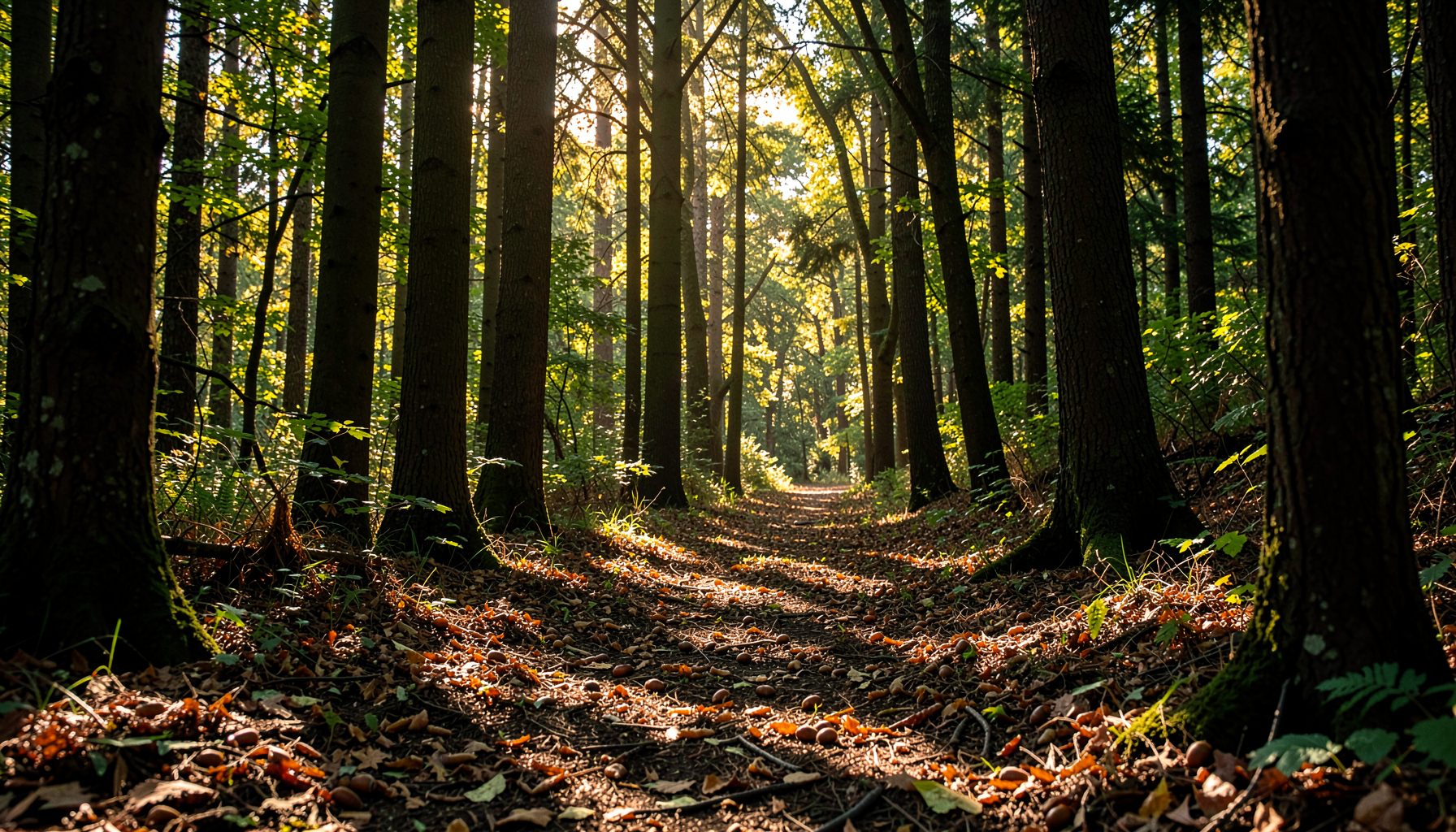
No photograph, however crisp, replaces boots on the ground. Once you have a short list of candidate sites, plan a visit at the right time of year. In the southern hemisphere, acorns ripen between September and April, depending on species and elevation. Visiting in late March through early May for Tasmania's oaks gives you the best chance of seeing both nuts and the distinctive lobed leaves in their full autumn colour.
Walk slowly. Old oaks often survive not as grand specimens but as gnarled, hollow veterans, sometimes reduced to a single living limb beside a crumbling stump. Look for remnant fence wire grown into the bark, a tell-tale sign that the tree has stood through at least one fencing era. A mature oak drops thousands of acorns over its lifetime, and any that fell in a hospitable spot may have grown into saplings. A circle of juvenile oaks around a decaying trunk is one of the most satisfying finds a seed hunter can make.
It is worth being patient and discreet. Some of these trees stand on private land, and a respectful knock on the door with a brief explanation of your project will go further than a long walk through someone's back paddock. Many landholders are pleased to find out their old oak has value beyond firewood, and a few have even joined their local Landcare group to protect what turns out to be a heritage tree.
From Photograph to Seed Collection Walk
The final step is turning your detective work into an actual seed collection. Plan the walk for a still morning, after a few days without heavy wind. Bring clean hessian bags, a notebook, gloves, and a long-handled hook for pulling down higher branches. Tag each tree's collection separately; even within one historic stand, individual trees vary enormously in acorn size, shape, and tannin content.
If you are organising a group walk, especially one with kids or first-time collectors, this family-friendly seed walk guide is a practical starting point. Older bushwalkers will tell you the best seed walks always finish with a billy tea and a yarn under the parent tree, which is, after all, why these old specimens earned their place in the landscape in the first place.
Old photographs give us something no satellite image or modern map can — a record of trees that people once stood next to and found worth remembering. The stands they document may have thinned, trunks may have fallen, acorns may have stopped falling for a hundred years. With a little archival digging and a good pair of boots, those forgotten crowns can seed the next generation of healthy forest.
If this approach stirs your curiosity, the Growing Native program offers more ways to get involved with seed collection, nursery partnerships, and watershed care. Whether walking a Tasmanian gully, a Victorian high-country gully, or a pocket of remnant bush closer to home, the same principle applies: every old photograph is a quiet invitation, and every recovered acorn is a small promise back to the land.