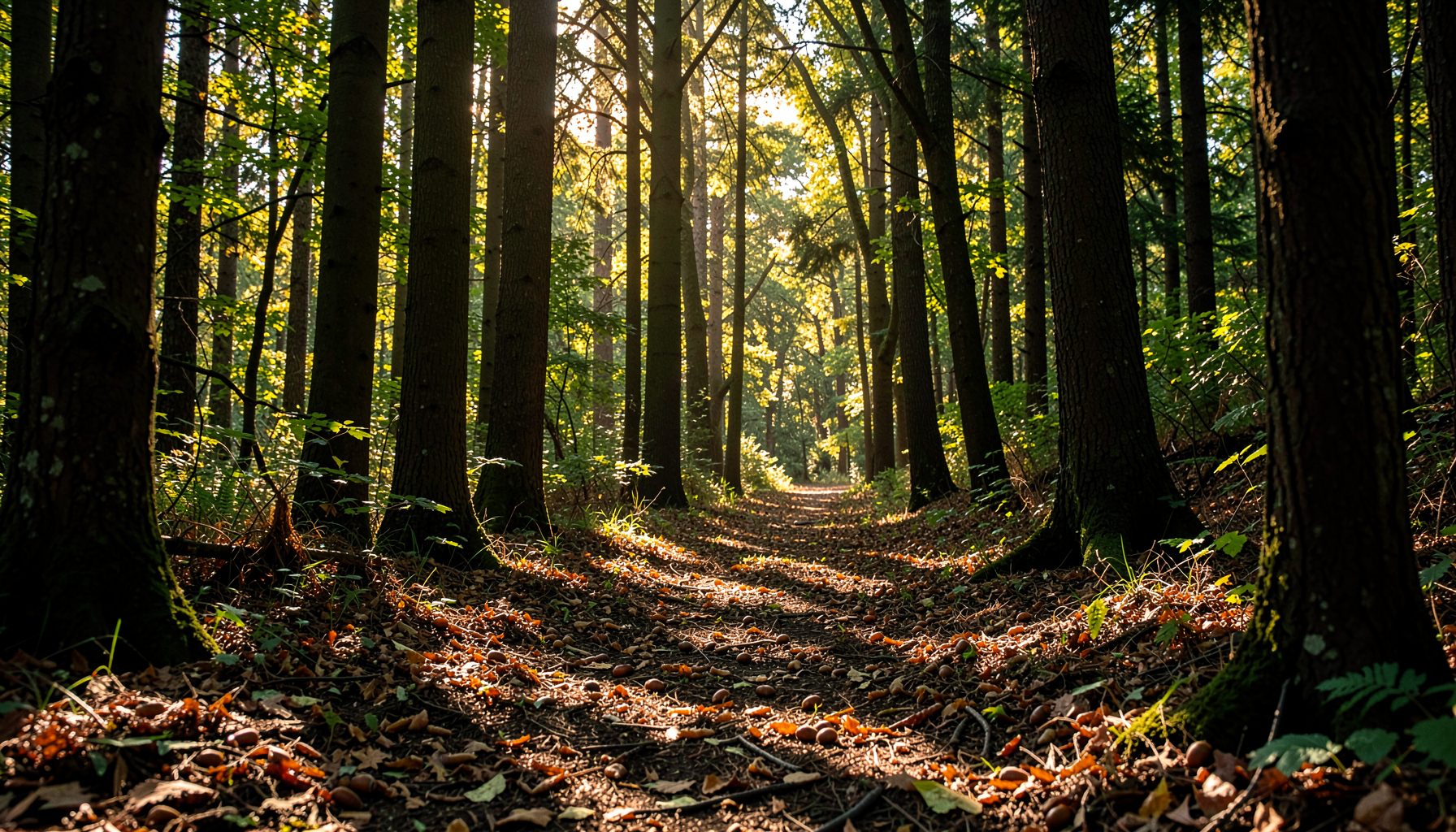
How to identify a northern red oak by acorns and bark
Northern red oak (Quercus rubra) is a large, long-lived hardwood of the eastern United States. It grows throughout the Potomac River watershed, where mature trees help stabilize soil, shade streams, and provide food and shelter for wildlife. Learning to recognize this species makes a walk through a forest, park, or neighborhood more meaningful.
Acorns and bark offer two of the most dependable clues, especially when leaves are changing color or have already fallen. The acorn gives you a seasonal and highly distinctive feature, while the bark becomes more useful as the tree ages. Looking at both together is more reliable than depending on a single characteristic.
A careful identification also supports responsible seed collection. Northern red oak acorns can become future streamside trees when gathered at the right time and handled properly. The process connects a familiar forest tree with practical watershed restoration.
Start with the acorn shape
A northern red oak acorn is generally oval to egg-shaped and about three-quarters to one inch long, although size varies with growing conditions. Its brown nut sits in a shallow, saucer-like cup called a cupule. The cup usually covers only the base quarter of the acorn, leaving most of the smooth nut exposed.
The cap is an important field mark. It has a thin rim and closely packed, overlapping scales that may look slightly hairy along the edge. The cup is often light brown, gray-brown, or tan, while the mature nut ranges from medium brown to reddish brown. Acorns may appear singly or in small clusters on the ground beneath the canopy.
Northern red oak acorns mature in two growing seasons. In the Potomac region, they commonly drop from late September through October, though weather, elevation, and local conditions can shift the timing. Fresh acorns should feel heavy for their size and have firm shells without holes, soft spots, or a sour odor.
Read the bark at different ages
Young northern red oaks often have smooth gray to gray-brown bark. As the trunk expands, shallow furrows develop and separate broad, flat-topped ridges. Mature bark is usually gray, charcoal gray, or brownish gray, with pale vertical lines sometimes running along the ridges. The overall texture is rugged without being deeply blocky.
Look at the main trunk rather than small branches, because young twigs can remain relatively smooth for years. On a mature specimen, the bark may show long, continuous ridges that run vertically up the trunk. Some ridges have a slightly plated or broken appearance, but they generally retain a broad, flattened profile.
Bark color changes with light, moisture, age, and lichen growth. A shaded trunk may look darker and greener than a sunlit one. For that reason, bark should be paired with the acorn cup, tree size, branching pattern, and leaves when available.
Compare nearby red oak species
Several native oaks produce acorns that can confuse beginners. Black oak (Quercus velutina) often has a deeper, more bowl-shaped cup with fine, fuzzy scales. Its bark is usually much darker and more irregular, with deep furrows and blocky ridges. The inner bark, if visible on a fallen twig or damaged branch, has a yellow-orange color, but bark should never be stripped from a living tree.
Scarlet oak (Quercus coccinea) also has a relatively shallow acorn cup, so its leaves and bark are useful supporting evidence. Its mature bark tends to have deeper fissures and more pronounced ridges, while the leaves usually have very deep, narrow sinuses. Pin oak (Quercus palustris) has smaller acorns with a shallow cup and typically grows in wetter soils; its lower branches often droop noticeably.
The table below summarizes practical distinctions. These are field tendencies rather than rigid rules, since individual trees vary and oaks can hybridize.
| Species | Acorn cup and nut | Mature bark | Helpful supporting clue |
|---|---|---|---|
| Northern red oak | Shallow saucer cup; large oval nut, mostly exposed | Gray-brown with broad, flat ridges and shallow furrows | Leaves have pointed lobes with bristle tips |
| Black oak | Deeper cup; often fuzzy scales; nut partly enclosed | Dark, deeply furrowed, blocky ridges | Yellow-orange inner bark on broken wood |
| Scarlet oak | Shallow to moderate cup; oval nut | Dark gray bark with deeper fissures | Very deep leaf sinuses and narrow lobes |
| Pin oak | Small nut in a shallow cup | Gray-brown, fairly tight ridges | Drooping lower branches and wet-site preference |
Use leaves and habitat as confirmation
When leaves are present, northern red oak usually has leaves with seven to eleven pointed lobes. The lobes are separated by shallow to moderately deep sinuses, and each lobe ends in a small bristle. Leaves are typically glossy medium green above and paler beneath, turning russet, brick red, or brown in autumn.
The leaves can resemble those of other red oak group species, so focus on the full pattern. Northern red oak leaves often have a relatively broad outline and less dramatically cut-in sinuses than scarlet oak leaves. A hand lens can reveal the tiny bristle tips, but they are generally visible without magnification.
This tree favors well-drained, fertile soils but adapts to a range of upland forest settings. In the Potomac watershed, it may occur on slopes, ridges, mixed hardwood stands, and edges near developed areas. A very wet site does not rule it out, but a consistently swampy location makes pin oak or another moisture-tolerant species more likely.
Check acorns before collecting
Begin beneath a likely tree and examine several acorns rather than selecting the first one you see. The cup should match the shallow, saucer-like form, and the nuts should be intact, firm, and free from insect exit holes. A small hole often indicates an acorn weevil or other insect, while mold, cracking, and shriveling reduce the chance of successful germination.
Compare fallen acorns with those still attached if the season allows. A tree may drop acorns from neighboring oaks, squirrels may carry them across considerable distances, and wind can move loose caps separately from nuts. Confirming the tree above the collection site helps preserve accurate species information.
Responsible gathering means leaving plenty for wildlife and avoiding damage to branches or roots. If you are participating in a community seed collection, follow the collection guide for timing, handling, sorting, and delivery requirements. Good collection practices protect the genetic diversity and viability of the seeds.
Follow a practical field checklist
A repeatable inspection makes identification easier for children, beginning naturalists, and experienced volunteers alike. Start several feet away to observe the tree’s size and trunk form, then move closer to study bark and fallen seed. Record the location and date if the tree may be revisited.
Use these checks in order:
- Find a mature acorn with a shallow cup and a mostly exposed, oval nut.
- Examine the trunk for gray-brown bark with broad, flattened ridges.
- Look for pointed, bristle-tipped leaves when the tree is in foliage.
- Compare nearby black, scarlet, and pin oaks before making a final identification.
- Leave damaged acorns behind and gather only where permission is provided.
A phone photograph can help with later comparison, especially if it includes the whole acorn, its cup, a section of trunk, and the surrounding habitat. Avoid relying on an isolated bark close-up, since lighting and lichen can make several oak species appear similar. Multiple views create a stronger record.
Connect tree identification with watershed care
Identifying a northern red oak is more than an exercise in naming a species. Oaks support birds, mammals, and insects, while their extensive roots help hold soil in place. Along the Potomac and its tributaries, healthy forest cover can reduce runoff, shade waterways, and improve conditions for aquatic life.
Growing Native focuses on this connection through its watershed restoration work. Collected native hardwood and shrub seeds are donated to state nurseries, where they can be grown into seedlings for streamside and restoration projects. Recognizing a tree in the field is the first step toward understanding its role in that larger system.
Families, schools, workplaces, and community groups can turn an autumn walk into useful conservation work. Those ready to take part can explore current volunteer opportunities, learn local tree identification, and help gather seeds suited to the watershed. Each sound acorn represents a possible future tree, even though successful restoration depends on careful collection, propagation, planting, and long-term stewardship.
Next time you find a broad-ridged oak beneath a fall canopy, inspect the acorn cup before moving on. Confirm the bark, compare neighboring species, and treat the forest as a living source of information and renewal. Then put that knowledge to work by joining a seed collection effort that helps grow healthier forests and cleaner waterways across the Potomac River watershed.