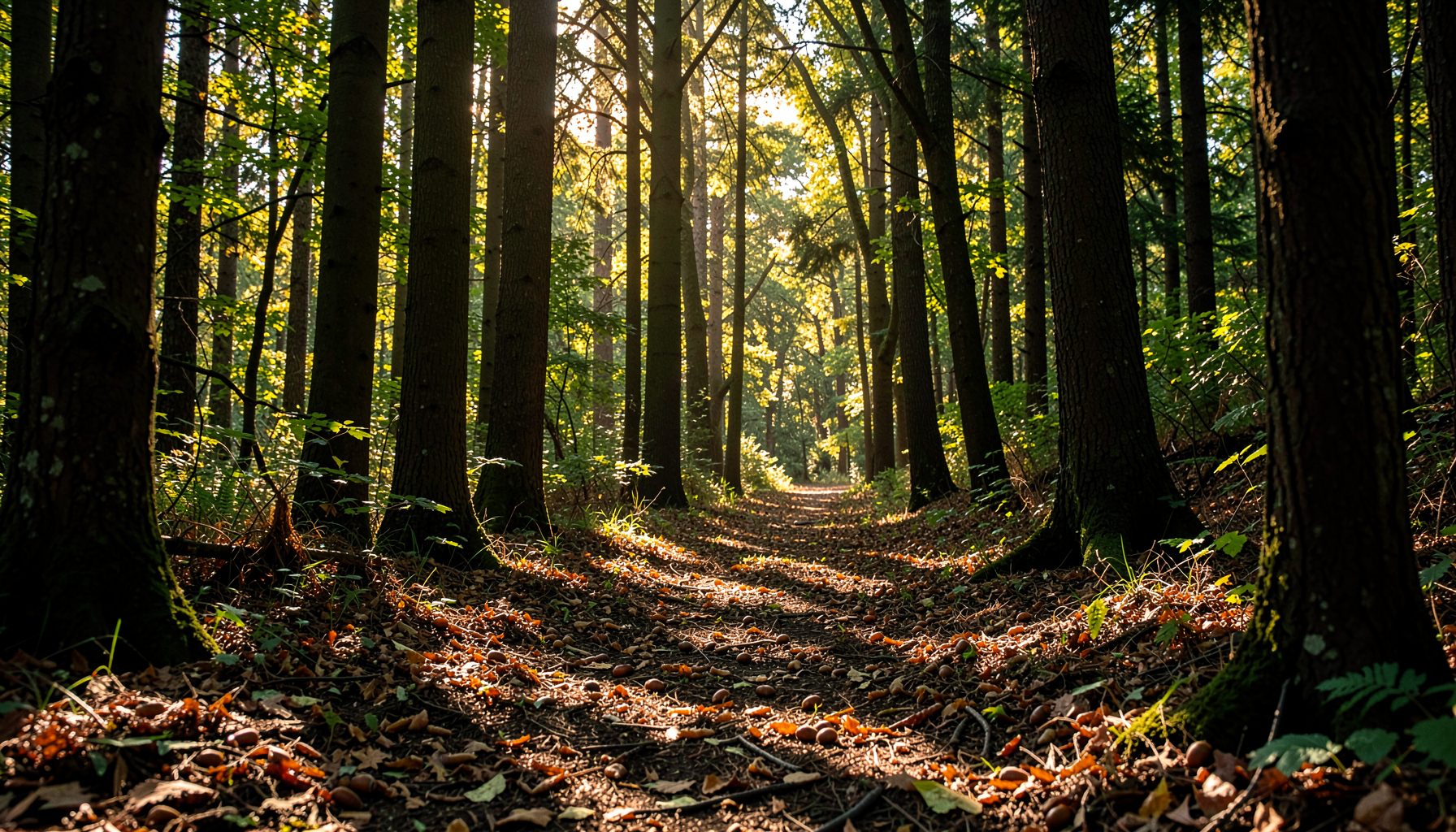
Estimating seed quantities for a native restoration project
A restoration project rarely needs a simple count of trees. Before collecting acorns, walnuts, berries, or other native seed, organizers must translate a landscape goal into planting sites, account for germination and survival, and allow for losses during collection, storage, transport, and nursery production. A realistic estimate helps prevent shortages without encouraging unnecessary harvesting.
The calculation also depends on the restoration method. A streamside buffer planted with nursery-grown seedlings has different requirements from a woodland restoration that uses direct-seeded nuts. Species, soil moisture, shade, wildlife pressure, and seasonal conditions all influence how many seeds become established plants.
For projects in the Potomac River watershed, careful planning supports the broader work of restoring forests, reducing erosion, and protecting water quality. The Growing Native program connects seed collection with state nurseries and long-term watershed restoration, giving volunteers a practical role in that process.
Start with the planting area and target density
First determine how much land will be restored. Measure the area in acres, square feet, meters, or another consistent unit. A map, GPS application, parcel plan, or planting contractor’s layout can help identify the actual planting zone rather than relying on the total property size.
Next select a target density. A project establishing seedlings across an open riparian field may use a regular spacing plan, while a woodland edge may include irregular clusters, shrub bands, or gaps for existing vegetation. The target should describe the number of desired established plants, not the number of seeds placed in soil.
For example, a half-acre buffer planted at 300 established stems per acre requires approximately 150 surviving plants. If the project includes three species in equal proportions, the initial target might be 50 established plants per species. Adjusting the proportions to match local habitat conditions is often more useful than dividing the total evenly.
Existing trees and naturally regenerating seedlings should also be counted. If a survey finds 40 healthy native stems already occupying the planting area, those plants reduce the number of new individuals needed. Marking them before site preparation avoids wasting seed and preserves natural regeneration.
Separate planting targets from seed requirements
The central calculation is based on several rates:
Seeds to collect = desired established plants ÷ (germination rate × establishment rate × usable-seed rate)
Each rate should be written as a decimal. A 70 percent germination rate becomes 0.70, and a 60 percent field establishment rate becomes 0.60. The usable-seed rate accounts for empty, damaged, immature, diseased, or otherwise unsuitable seed.
Suppose a project needs 200 established seedlings. If 75 percent of collected seeds are usable, 70 percent germinate in the nursery, and 65 percent survive planting, the estimate is:
200 ÷ (0.75 × 0.70 × 0.65) = approximately 586 seeds
Rounding upward is sensible because biological results vary. A collection target of 600 to 625 seeds provides a modest operating margin without treating every seed as equally viable.
If seeds are being grown at a nursery, use nursery-specific germination and culling records whenever possible. A species may have a high laboratory germination rate but a lower production yield after stratification, transplanting, root development, and quality screening. The most valuable figures are those from the same species, source region, and production system.
Use realistic rates for native species
Seed viability differs widely among native hardwoods and shrubs. Fresh acorns can perform well under suitable conditions, but they may dry out, mold, or be eaten before planting. Walnuts, hickories, persimmons, dogwoods, and shrub seeds each have their own collection windows, storage requirements, dormancy patterns, and germination behavior.
When reliable local data are unavailable, use conservative planning assumptions rather than optimistic ones. For a preliminary estimate, many teams may model 60 to 80 percent usable seed, 50 to 80 percent germination, and 50 to 80 percent establishment, then revise the figures after small-scale testing. These are planning ranges, not universal standards.
The strongest estimate comes from a short pilot. Collect a manageable sample, inspect and weigh it, test viability where appropriate, and send a known quantity through the intended nursery process. Compare the number of seeds received with the number of healthy seedlings produced. That observed conversion rate can replace several uncertain assumptions in the larger calculation.
Species diversity also affects the total. A project requiring six native species should estimate each species separately, since collecting 600 mixed seeds does not guarantee enough viable material from every ecological role. Set minimums for canopy trees, understory trees, shrubs, and species suited to wet or seasonally flooded ground.
Build a practical calculation
A spreadsheet makes the estimate transparent and easy to update. Create one row for every species and record the restoration zone, desired established plants, collection source, seed type, expected viability, germination rate, establishment rate, and final collection target.
The calculation should distinguish between seeds collected, seeds accepted by the nursery, and seedlings planted. These quantities are often different. Sorting may remove damaged material, nursery staff may cull weak plants, and field crews may plant fewer seedlings if weather or site access changes.
| Planning factor | Example value | How it affects the estimate |
|---|---|---|
| Desired established plants | 200 | The final biological target |
| Usable seed rate | 75% | Removes empty, damaged, or poor-quality seed |
| Nursery germination rate | 70% | Estimates seeds that produce seedlings |
| Field establishment rate | 65% | Estimates seedlings that survive planting |
| Calculated collection need | 586 | 200 ÷ (0.75 × 0.70 × 0.65) |
| Rounded collection target | 625 | Adds a practical reserve |
For direct seeding, replace the nursery germination figure with the expected emergence rate under field conditions. Direct-sown acorns may need a larger reserve because rodents, deer, drought, compaction, flooding, and weed competition can reduce emergence and survival. Use protective cages, tubes, mulch, or broadcast timing to improve the establishment rate when the site allows.
Keep a record of assumptions and actual results. After planting, document the number of seeds collected, seedlings delivered, seedlings planted, and surviving plants during the first and second growing seasons. Those observations create a local restoration seed calculator that becomes more accurate with each project.
Add reserves without overharvesting
A reserve is useful, but it should be based on known risks. Adding 10 to 20 percent to the calculated amount may cover minor losses in collection or transport. A larger reserve may be justified for a difficult species, a short collection season, or a site with high wildlife pressure.
Do not automatically double the collection target. Excess harvesting can remove food and reproductive material from natural populations, especially during poor mast years when wildlife depends heavily on acorns and nuts. Collect across multiple healthy source trees and locations, follow landowner permissions, and leave sufficient seed for natural regeneration.
A reserve can also be distributed among species rather than applied equally. If one species has reliable viability and another has unpredictable germination, the uncertain species may deserve a larger buffer. Similarly, wetland species may need a different allowance from upland species because planting conditions and flood exposure differ.
- Use local seed sources suited to the restoration region and watershed.
- Set species-specific targets instead of collecting an undifferentiated quantity.
- Record collection dates, locations, parent trees, and handling conditions.
- Coordinate early with the receiving nursery about packaging, labeling, and minimum quantities.
- Recalculate after viability testing, nursery acceptance, or a pilot planting.
Match seed estimates to site conditions
A sound seed quantity cannot compensate for an unsuitable planting design. Inspect soil moisture, sunlight, slope, drainage, invasive plants, deer browse, flooding patterns, and nearby seed sources before finalizing the target. A streamside project may need dense shrub coverage near the water and larger tree spacing farther upslope.
Erosion control goals can change the planting mix. Fast-establishing shrubs may stabilize vulnerable banks, while deep-rooted trees contribute shade and long-term soil structure. In a floodplain, survival rates may be lower if seasonal water levels are unpredictable, so the estimate should reflect the actual planting zone and timing.
Consider whether all target plants must be present at the same time. Some restoration plans prioritize a minimum number of living stems after one year, while others aim for a diverse stand that can thin naturally over several years. Establishing 300 seedlings may be appropriate when long-term thinning is expected, but the project should state that clearly.
Educational planning strengthens the calculation. Volunteers who can identify native species accurately are more likely to collect the right seed at the right maturity stage. Growing Native’s tree identification resources can help schools, families, and community groups connect collection work with forest ecology and watershed health.
Coordinate collection and restoration partners
Seed estimates become actionable when the collector, nursery, land manager, and planting crew share the same numbers. Before a collection event, confirm which species are wanted, how much can be accepted, when seed should arrive, and what condition it must be in. A nursery may prefer smaller, frequent deliveries over one large shipment that arrives after the ideal processing window.
Label every batch with species, collection date, general source location, and collector group. Keep species separate during gathering and transport. Accurate records protect genetic and ecological information and make it easier to trace poor results back to seed quality, storage, or site conditions.
Community events can supply substantial quantities when they are organized around clear targets. Assign collection zones, provide identification guidance, and explain how to reject immature or damaged seed. Groups seeking participation ideas can use this community seed drive guide to connect local outreach with a defined restoration need.
Review progress during the season rather than waiting until collection closes. If one species reaches its target early, shift volunteer attention to a species with a shortfall. This approach improves balance, reduces pressure on heavily collected trees, and keeps the final seed inventory aligned with the planting plan.
Bring the estimate into the field by writing down the desired number of established plants, applying species-specific conversion rates, and adding a measured reserve. Then share the calculation with the people collecting, growing, and planting the seed. Visit Growing Native to find ways to support native seed collection and watershed restoration, and turn careful arithmetic into healthier forests and cleaner streams.