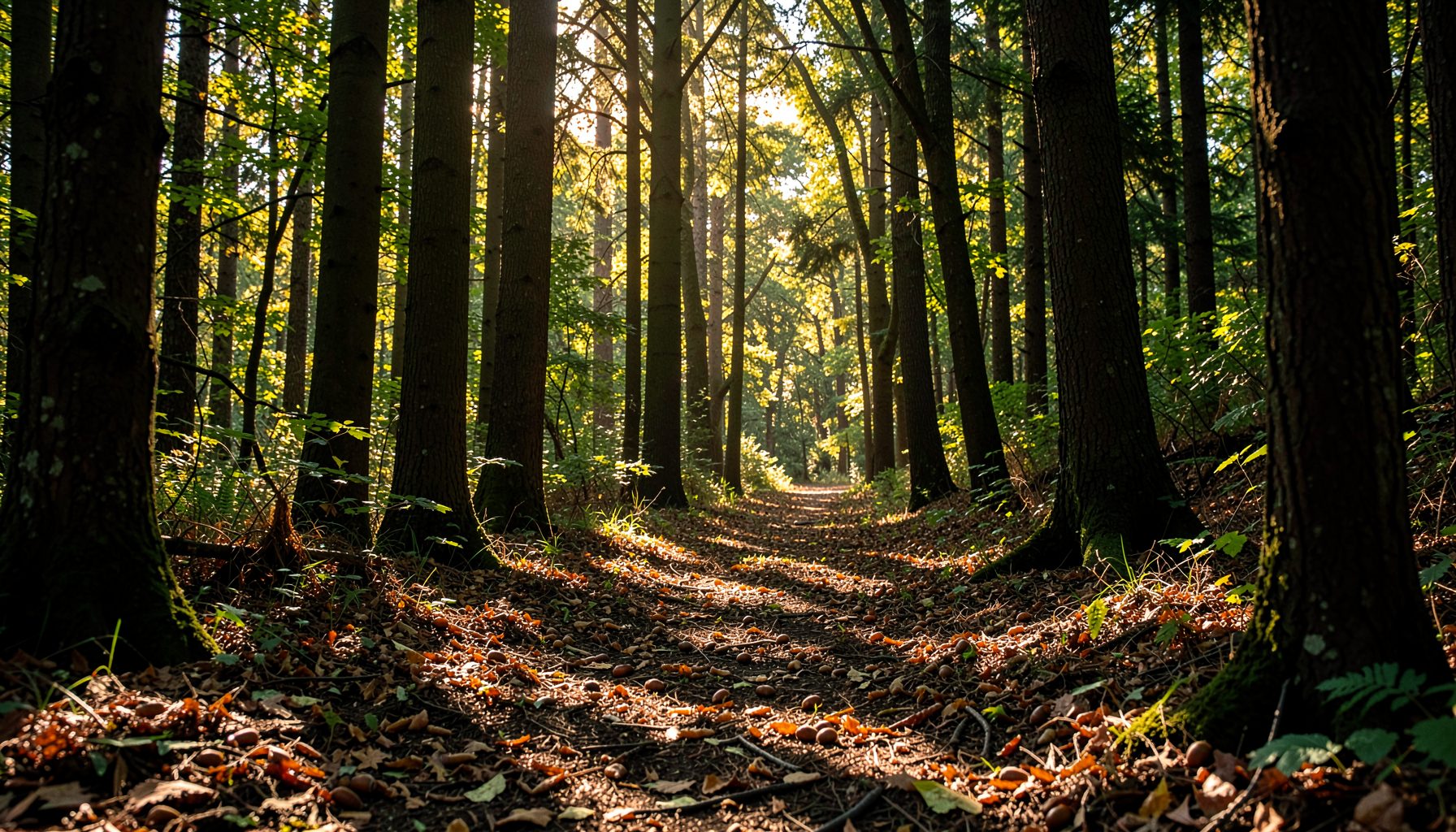
How to spot hickory trees in a mixed deciduous forest
Spotting a hickory among oaks, maples and tulip poplars depends on several clues agreeing. Bark may narrow the field, a feather-like leaf may support the identification and a nut in the litter can settle it. Trained eyes learn to separate those signals first, rather than trusting one striking feature and rushing to a name on a damp September morning.
Hickories belong to the genus Carya and are native to North America, not Australia. That distinction matters when you meet a smooth-leaved shade tree in Melbourne or a walnut growing in a Tasmanian garden. Australian readers can learn the North American species through clear photographs and living trees in documented botanical collections, while using local bushland to sharpen close observation.
Southern Australia also reverses the seasonal timing you may know from North America. Hickories release fruit during the northern autumn, whereas Melbourne, Adelaide and Sydney experience winter from June to August, when deciduous street trees are shedding leaves. Mark the local changes instead: leaf colour, bare crowns, swelling buds and the litter accumulating beneath each tree.
Walk in familiar places such as Wollemi National Park in New South Wales or the Blue Mountains west of Sydney, and study the outlines, leaf arrangements and bark textures of eucalypts and wattles. Australians commonly call eucalypts gums, but that broad label does not identify a species. Those walks are excellent training for separating textures and silhouettes, skills you can transfer to a mixed deciduous forest.
Begin with the tree’s overall shape
See the tree from across the clearing before approaching. Many hickories have a fairly straight trunk, rounded crown and grey bark broken into narrow ridges or tight plates. Against a blocky oak or a spreading maple, that restrained profile can be noticeable, although height and form vary with species and site.
Texture varies within the group. Some keep shallow furrows; others develop loose scales or long shaggy strips, especially shellbark hickory. Water oak and tulip poplar can imitate parts of this appearance. Compare cracks, plates and fibres visually, without stripping bark, using bark and nut clues as a useful side-by-side starting point.
Change your viewing angle before deciding. A ridged trunk obvious from one direction may disappear behind an oak limb from another. Note the crown-to-trunk proportion, where branches leave the bole and whether the plates are small, square-ish or long and fibrous. Record bark separately from leaf and fruit notes, because these features often identify different species.
Read the leaf and bud pattern
Now inspect foliage without pulling down a branch. A hickory leaf is pinnately divided, usually with five to nine leaflets on a central stalk and one terminal leaflet. The leaflets are generally pointed, oval to lance-shaped and finely toothed. Leaves alternate along the twig, so one begins to the side of the previous leaf rather than directly opposite it.
That arrangement provides a useful cross-check. Ash also has feather-like leaves, but its leaflets occur in opposite pairs. North American poison ivy has three leaflets, yet they meet at the end of a short stalk rather than a long central axis. Walnut foliage can also look similar, so confirm the pattern with buds and fruit.
Winter buds add another test. Hickory buds often have overlapping, pointed scales that create a compact, tapered twig tip, sometimes likened to a horse’s head. Bud position is alternate, matching the leaves. Hold a ruler beside the twig or photograph the bud against your palm to record its size, then watch buds swell and leaves emerge when possible. One photograph shows only a moment in the tree’s yearly cycle.
Confirm with nuts and seasonal evidence
Fruit provides strong confirmation. A hickory nut sits inside a husk that may be smooth or ribbed; depending on the species, it splits into four sections, opens along a seam or stays closed. The inner shell is hard and the kernel is smaller than a familiar walnut. Bitternut hickories have thin husks, while shellbark hickories can carry thick, coarse coverings. A single split husk on the ground can settle a question that foliage alone leaves open.
Do not rely on colour alone. Fresh husks may be green before turning brown, and old fruit can become almost black. Examine shape, thickness, ridges and splitting patterns, then inspect the shell of a naturally fallen nut where appropriate. A photograph with a ruler beside the fruit records scale more accurately than a handful in your palm.
Timing needs translating for Australian learners. Around the Potomac region, many hickories drop fruit in September and October. Across southern Australia, the comparable deciduous period falls from June to August, so street-tree litter offers useful practice. London planes, ornamental walnuts and crepe myrtles may lose leaves or fruit nearby, but they are not hickories without compound-leaf and husk evidence.
Separate hickory from its neighbours
In North American forests, oak, maple, beech, ash, elm and black walnut can all compete for attention. Notice how each tree fills the canopy. Hickory foliage can create a fine-textured crown, while oak appears heavier and maple broader. Treat this impression as supporting evidence, never as a replacement for checking leaflets, buds and fruit.
Habitat helps organise a search without dictating the answer. Hickories occur across eastern and central North America, from moist bottomlands to upland woods, often beside tulip poplar, oak and maple. Begin with trees showing the expected crown and trunk, then move closer. Pay attention to the soil and companion plants as well: hickories can occur where the canopy is open enough for understorey vegetation to receive light. A species may occur beyond its textbook range, so habitat should filter possibilities rather than issue a verdict.
Australian bushland also warns against assuming a familiar pattern. In Wollemi National Park, a tall pale trunk might belong to a stringybark eucalypt; near Melbourne, a planted maple may stand beside a wattle. Use a public botanic garden or council arboretum to practise close looking, then return to local trees with firmer notes about their actual features.
Turn observation into a repeatable field routine
Build a repeatable routine. Record the tree’s position, note crown and bark from a distance, then photograph a complete leaf and twig, a bud, fruit and any damage. Move from broad pattern to close fit, label uncertain trees as probable and revisit them through the year. Seasonal comparison teaches variation faster than a single walk. A second observer comparing notes is useful when bark and fruit are absent.
Keep the kit simple: binoculars, a camera, a notebook and a hand lens if you already use one. Stay on marked paths, ask before entering private land and never cut twigs or strip bark. Australian plant buying runs through big-box hardware stores that stock common landscaping trees and specialist native nurseries that offer local species in tube stock or as advanced trees. Read the species and provenance labels rather than relying on sales language.
Seed collecting raises the standard from identification to tree health. Look for cankers, dieback, lesions and mould before taking anything, and keep collections traceable. Growing Native’s seed collection guidance explains why seeds from visibly diseased trees are not collected, because poor health can compromise the next generation. In Australia, check state quarantine and Commonwealth biosecurity rules before moving seeds, nuts or other plant material across borders.
Put that trained eye to work for a living forest. Join Growing Native’s volunteer opportunities, helping identify trees and collect native hardwood and shrub seeds for state nurseries. Individuals, families, schools, community groups and workplaces can all contribute to reforestation, erosion control and healthier waterways across the Potomac River watershed.
Before your next visit, compare one tree’s complete leaf, twig buds, bark and fallen fruit instead of photographing a single impressive leaf. Every confirmed record helps volunteers support the forests where land meets streams and protect water quality for communities downstream.