How to Identify a Northern Red Oak in Winter
Winter strips away the leaves that make many trees easy to recognize, but it also exposes details that are hidden during the growing season. The northern red oak, Quercus rubra, has a distinctive combination of deeply ridged bark, stout twigs, pointed buds, and a broad, upright shape. Learning to read these features makes identification possible even after autumn color has faded.
Correct identification matters beyond naming a tree. Northern red oaks provide acorns for wildlife, help stabilize forest soils, and contribute to diverse hardwood habitats throughout the Potomac River watershed. A careful winter observation can also help volunteers collect the right native seeds and understand how individual trees fit into a larger restoration effort.
Start with habitat and overall form
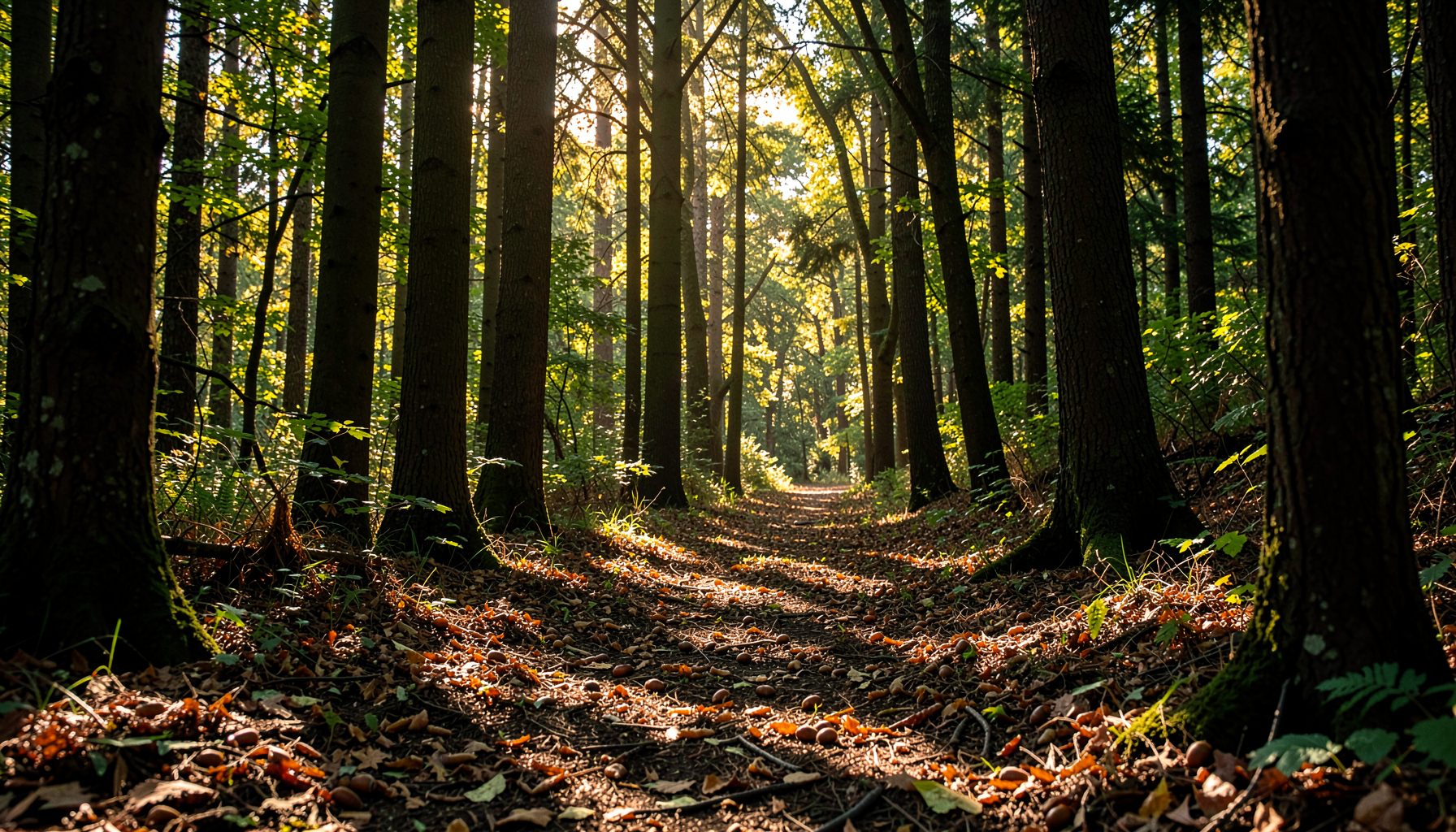
Northern red oak is common in upland forests, wooded slopes, well-drained ridges, and mixed hardwood stands. It can also grow near roads, parks, and older residential properties when the soil is deep enough. Look for a large deciduous tree with a long, mostly straight trunk and a high crown of spreading branches.
Mature trees often reach 60 to 80 feet, with exceptional specimens growing taller. Young northern red oaks may have a narrow or somewhat irregular crown, while older trees develop a rounded, open canopy. The overall silhouette is useful, but it should be treated as an initial clue rather than proof because many oak species share a similar broad form.
Pay attention to the surrounding forest. Northern red oak frequently grows with white oak, black oak, tulip poplar, hickory, beech, and red maple. A tree standing on a dry upper slope is more likely to be a red oak than one rooted in saturated bottomland, although local conditions can produce exceptions.
Read the bark from a distance
The bark of a mature northern red oak is dark gray to gray-brown and divided into long, narrow ridges. A helpful feature is the pattern of shallow furrows and flat-topped ridges, which often appear as vertical strips running up the trunk. Some ridges show pale gray lines or lightly broken surfaces that create a subtle ski-track appearance.
Run your eyes from the base of the trunk upward rather than focusing on a single patch. Bark texture changes with age, weather, fire damage, and growth rate. Very young trees may have smoother gray bark, while older specimens can develop deeper fissures and rougher plates. The bark should support identification alongside twigs and buds.
Northern red oak bark generally lacks the shaggy, peeling appearance of shagbark hickory and does not form the blocky, dark plates often associated with black oak. Its ridges are usually more continuous and vertically organized than the irregular scales of some other oaks.
Inspect twigs, buds, and leaf scars
The twigs offer some of the best winter clues. Northern red oak twigs are typically slender to moderately stout, gray-brown, and smooth or only slightly hairy. The terminal buds at the ends of twigs are pointed and often reddish-brown. They may be clustered near the tip, with several side buds arranged around the end of the branch.
Look closely at the bud scales. Northern red oak buds tend to be somewhat angular and sharply pointed, unlike the rounded terminal buds of many maples. The buds are usually smaller and less fuzzy than those of black oak. A hand lens can reveal fine hairs and scale details, but these characteristics are often visible with a careful look in good daylight.
The twig arrangement is alternate, meaning side buds and former leaves do not emerge in directly opposite pairs. Small, persistent leaf stalks or the circular scars left where leaves detached can reinforce the identification. If you find a twig bearing a few dried leaves, examine the shape of those leaves before relying on bark alone.
Use fallen leaves and acorns as supporting evidence
Even after the canopy is bare, winter ground litter may preserve recognizable leaves. Northern red oak leaves are usually large, with seven to eleven deep, pointed lobes. The lobes often have bristle tips, a key feature of the red oak group. The spaces between lobes are typically U-shaped or moderately rounded rather than sharply cut to the midrib.
A fallen leaf may be curled, faded, or partly decomposed, so look for several intact examples beneath the crown. Northern red oak leaves can remain attached to young branches into winter, a behavior called marcescence, although this is more common on smaller trees and lower branches. The leaves are often dull brown by then, but their outline and pointed lobes remain useful.
Acorns provide another valuable clue when they are still present. Northern red oak acorns are generally oval to egg-shaped, with a shallow, saucer-like cup that covers only part of the nut. They mature in two years and may be found beneath the tree, in leaf litter, or cached nearby by squirrels and birds. Compare several acorns because size and color vary with age and growing conditions.
The following field comparison helps separate this species from common lookalikes. Use several traits together instead of deciding from one feature.
| Feature | Northern red oak | Black oak | White oak | Pin oak |
|---|---|---|---|---|
| Winter bud | Pointed, reddish-brown, moderately slender | More clustered and often grayish or slightly fuzzy | Rounded, blunt, and less sharply pointed | Small, pointed, often reddish-brown |
| Bark | Gray-brown with long, fairly narrow ridges | Darker, rougher, often blocky plates | Light gray with scaly or flaky ridges | Gray-brown, tighter and less rugged |
| Fallen leaf | Deep lobes with bristle tips | Irregular lobes, often yellowish beneath | Rounded lobes without bristles | Deep, narrow lobes with bristles |
| Acorn cup | Shallow cup covering part of nut | Deeper cup, often hairy inside | Cup enclosing about one-quarter of nut | Small cup on a long stalk |
| Typical setting | Upland slopes and well-drained soils | Dry ridges and sandy uplands | Broad range, often rich woods | Moist lowlands and floodplains |
Separate it from similar oak species
Black oak is one of the most frequent sources of confusion. Its bark is often darker and more rugged, and its twigs may have fuzzy terminal buds. Black oak leaves commonly have yellow-orange patches or a yellowish underside, but winter leaves may be too weathered for that clue to remain. A combination of pointed red oak buds and long, vertically ridged bark is more persuasive.
White oak belongs to a different oak group and usually has rounded leaf lobes without bristle tips. Its winter buds are blunt or rounded, making them a particularly useful contrast with the sharp buds of northern red oak. White oak bark is commonly lighter gray and may appear flaky or loosely scaled rather than deeply furrowed.
Pin oak can resemble northern red oak because both have pointed lobes and bristle tips. Its growth habit is often more distinctive: slender lower branches angle downward, while upper branches may point upward, creating a strongly tiered crown. Pin oak favors moist, poorly drained soils and often has smaller twigs and leaves. Site conditions and branch architecture can help resolve an uncertain identification.
When a tree seems intermediate, consider the possibility of a hybrid. Oaks cross readily, and planted trees may also come from cultivars or regional varieties. Record the strongest clues, photograph the bark and terminal twig, and avoid making a confident identification from one unusual leaf or acorn.
Build a reliable winter field routine
A consistent process reduces mistakes and makes observations more useful for education, conservation, and seed collection. Start several feet away, then move closer for bark and twig details. Check more than one branch and, when possible, compare the tree with nearby specimens.
For volunteers working with Growing Native, accurate tree recognition supports the collection of native hardwood seeds for future streamside plantings. The organization connects community members with restoration work across the watershed, where correct species identification helps state nurseries grow locally appropriate seedlings.
Use this short routine when examining a leafless oak:
- Confirm that the tree is deciduous and has an alternate twig arrangement.
- Study the trunk for long gray-brown ridges and relatively narrow furrows.
- Examine several terminal buds for a pointed, reddish-brown shape.
- Search beneath the crown for bristled leaves and shallow-cupped acorns.
- Record the habitat, crown shape, photographs, and any features that suggest a lookalike.
For additional practice, consult Growing Native’s tree identification resources, especially materials on native hardwoods, forest ecology, and watershed health. Comparing photographs with living trees is more effective than memorizing isolated descriptions, because winter appearance changes with age, weather, and site conditions.
Turn winter observations into stewardship
A winter walk can reveal more than a species name. It can show how mature trees hold soil on a slope, where acorns feed wildlife, and which forest species are regenerating beneath the canopy. These observations connect individual identification skills with the health of streams and wooded corridors throughout the watershed.
If you are planning a field outing, use the program’s seed collection sites to find opportunities that match your location and season. Collect only when authorized, follow local guidance, and leave enough seed for wildlife and natural regeneration. Photographs, notes, and careful identification are valuable contributions even when collection is not taking place.
Northern red oak is easiest to recognize in winter when several clues point in the same direction: a large upland hardwood, gray-brown ridged bark, pointed reddish buds, bristled leaf remnants, and shallow acorn cups. With practice, these details become familiar. Take that knowledge outdoors, join a local restoration activity, and help turn careful observation into healthier forests and cleaner waterways.